
Write Blogs With AI Without Sounding Generic, A Repeatable Workflow
Learn a repeatable workflow to write blogs with ai, from brief to publish: intent, outline, drafting, editing, on-page SEO, and refreshes.
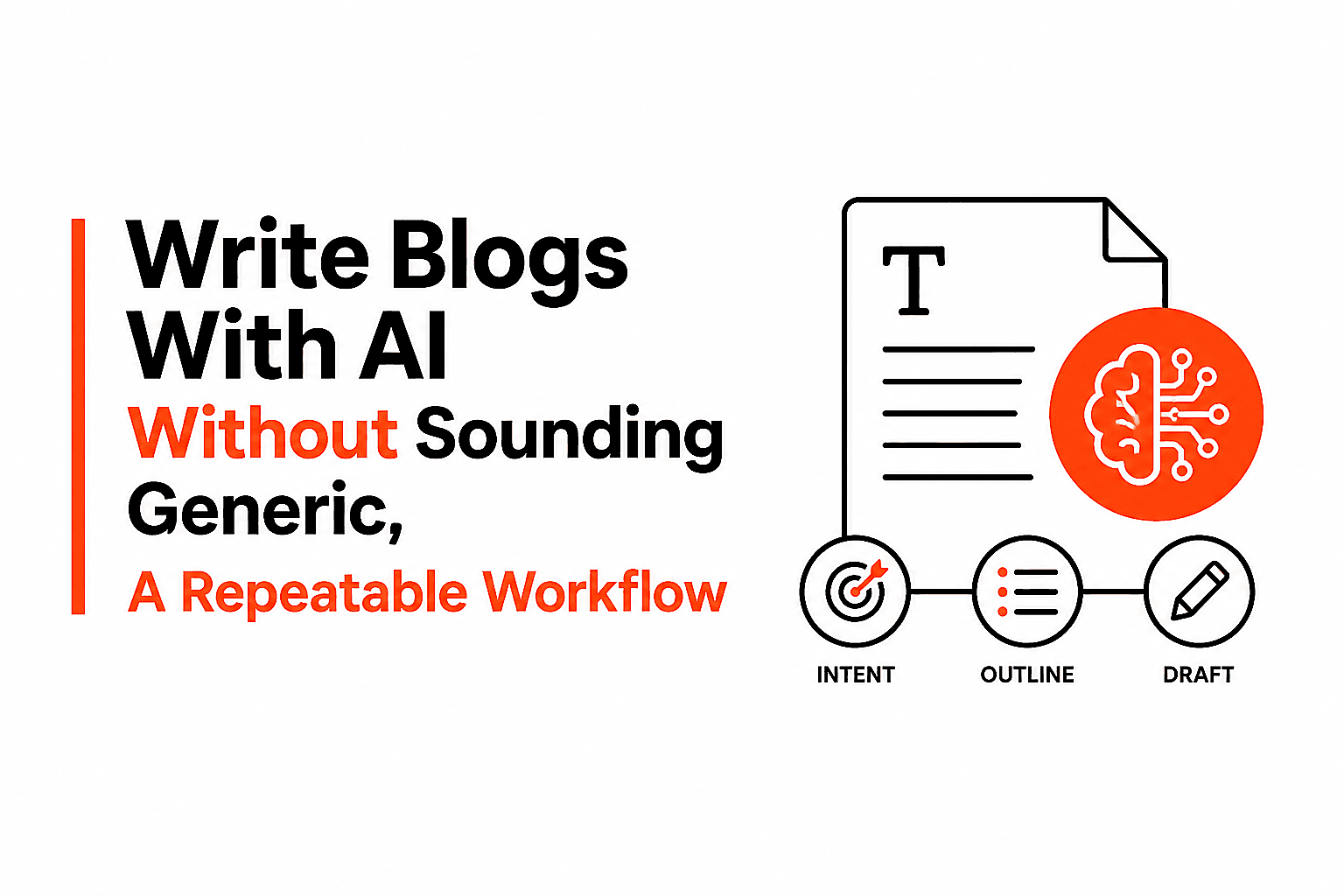
Write blogs with ai by using it as a structured assistant for research, outlining, drafting, and SEO checks, while keeping humans responsible for intent, accuracy, and final voice.
- Use an intent-first SOP (brief → SERP intent → outline → draft → edit → on-page SEO → publish → refresh) to avoid generic AI output.
- Prevent hallucinations with a sources-first prompt, a claim-by-claim fact check, and a simple “unknowns list” before publishing.
- Finish with SEO details AI often misses: snippet targeting, internal linking rules, and a refresh cadence tied to rankings and conversions.
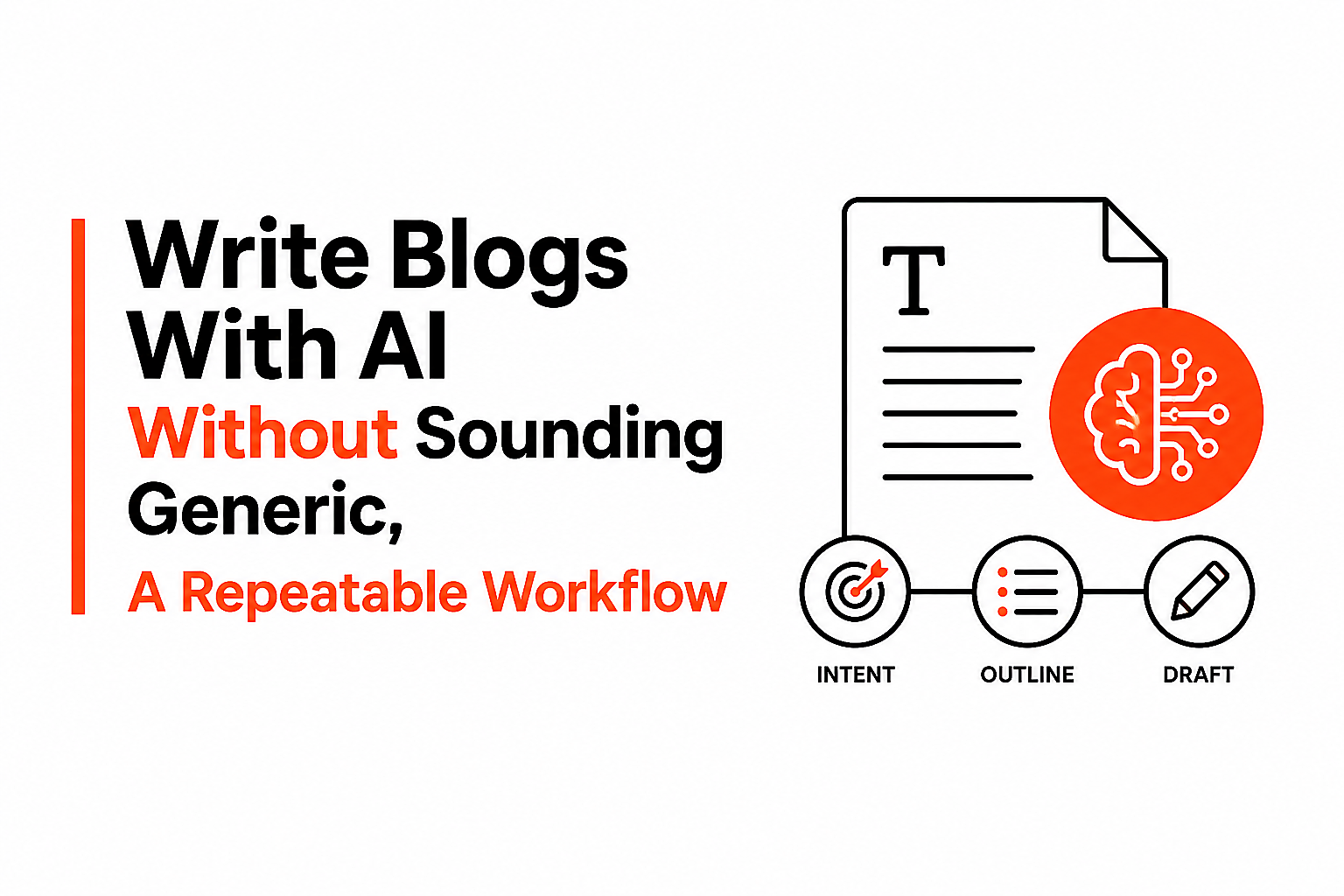
What writing blogs with AI really means and where it helps most
Writing blogs with AI works best when AI handles repeatable text-production tasks and a human owns strategy, truth, and tone.
Definition that sets expectations (so you do not ship “AI slop”)
“AI-assisted blogging” is a workflow where you provide constraints (keyword, audience, angle, sources, outline rules) and the model generates drafts and variations that you edit into a publishable article. The key expectation: AI is fast at generating plausible language, not guaranteed truth. Treat the draft like a junior writer: helpful, but it needs supervision.
What to automate vs keep human-led
Use this simple split to decide what belongs to AI and what belongs to you:
- AI is strong at: brainstorming angles, creating multiple outlines, expanding bullet points into paragraphs, rewriting for clarity, generating FAQ drafts, and producing on-page elements like meta descriptions when you provide constraints.
- Humans must own: search intent decisions, source selection, fact checking, product or legal claims, original experience, and final editing for brand voice.
Where AI saves the most time in real workflows
In our experience working with agency-style content calendars, the biggest time savings come from standardizing the brief and outline stage first, not from letting AI freestyle the whole post. Once the brief is consistent, drafting and formatting become largely mechanical.
A quick “should we use AI here?” checklist
- Use AI if the topic is stable, informational, and you can supply credible sources or internal expertise.
- Be cautious if the topic is YMYL-adjacent (money, health, legal) or depends on fast-changing stats.
- Avoid autopublishing if you cannot verify claims or if the piece needs original reporting.
The repeatable workflow from brief to publish to write blogs with AI without losing quality
A repeatable SOP is the fastest way to write blogs with ai that are consistent, accurate, and aligned with what searchers actually want.
Step 1: Build a one-page content brief (10 minutes)
Use a brief that forces clarity before any drafting. Copy this template:
- Primary query: (exact phrase)
- Search intent: informational / how-to / comparison / troubleshooting
- Audience: who is reading and what they already know
- Outcome: what the reader can do after reading
- Angle: what makes this piece different (workflow, checklist, example)
- Must-include: definitions, constraints, tools, warnings
- Sources list: links you trust (docs, standards, first-party data)
- Claims to avoid: anything you cannot verify
Practical rule: if you cannot fill the sources list, do not draft yet. Go gather sources or narrow the scope.
Step 2: Map SERP intent in 15 minutes (without overthinking)
SERP intent mapping means copying what Google is already rewarding, then improving it with clearer structure and stronger verification.
- Open the top results and note the dominant format (guide, list, template, tutorial).
- List the repeated subtopics across results (these are “table stakes”).
- Identify gaps: missing steps, weak examples, vague definitions, no checks.
If you are new to on-page planning, this pairs well with a simple primer on how to do seo for blog content so your structure matches real queries.
Step 3: Generate an outline that forces specificity
Use AI to propose 2 to 3 outlines, but constrain it. Prompt pattern:
- Input: brief + list of required sections + sources
- Constraints: H2/H3 hierarchy, include checklists, avoid unsupported stats, include a short example
- Output: outline only, plus “missing info” questions
Choose the outline that matches intent and has the fewest “hand-wavy” sections.
Step 4: Draft in blocks, not in one giant prompt
Block drafting reduces generic filler and makes editing easier. Draft one H2 section at a time with the same constraints:
- Section goal (one sentence)
- 2 to 4 key points to cover
- Allowed sources
- Forbidden claims (anything unverified)
When we tested section-by-section drafting versus one-shot full-article generation, the biggest improvement was fewer repeated sentences and less “definition padding” that editors have to cut.
Step 5: Edit with a 3-pass system
Use three passes that each have a single job:
- Structure pass: does each section answer the heading, and does the order match the reader journey?
- Truth pass: check each factual claim, tool claim, or process claim. If you cannot verify it, remove or rephrase to a conditional.
- Voice pass: tighten sentences, add concrete examples, and remove hedging.
If you want a beginner-friendly checklist for SEO structure, this guide on write seo friendly article basics can help you sanity-check headings, intent, and on-page elements.
Step 6: Publish, then schedule the refresh before you forget
Set a refresh reminder at publish time, not “later.” A simple cadence that works for most informational posts:
- 2 weeks: verify indexing, check for query mismatch, fix obvious UX issues.
- 6 to 8 weeks: add missing subtopics based on impressions and PAA, improve internal links.
- Every 3 to 6 months: update examples, screenshots, and any time-sensitive statements.
Make AI drafts sound human and stay accurate
Human-sounding AI content comes from constraints and editing, while accuracy comes from sources-first drafting and claim-by-claim verification.
Use a “sources-first” prompt so the model cannot improvise
Before drafting, give the model only the sources you trust and tell it to cite them in-line for any non-obvious claim. Prompt skeleton:
- Task: draft section X for keyword Y
- Allowed sources: (paste links or excerpts)
- Rule: if a claim is not supported by the provided sources, say “not enough info” and ask a question
- Style: short sentences, practical steps, no fluff
This reduces hallucinations because the model is rewarded for staying inside a narrow sandbox.
Anti-hallucination checklist (copy/paste)
- Underline every sentence that contains a number, date, “best,” “always,” or “guarantees.” Verify or remove.
- Check every named tool, policy, and feature claim against primary documentation.
- Replace absolutes with conditions when reality depends on context (“often,” “typically,” “in most cases”).
- Add an “unknowns” line if you cannot verify something yet (and do not publish until it is resolved).
Brand voice editing that actually changes the output
Most “make it sound human” edits fail because they are vague. Use a voice rubric with measurable traits:
- Sentence length: target 12 to 18 words on average; break up long lines.
- Jargon limit: no unexplained acronyms; define once then use sparingly.
- Concrete over abstract: swap “optimize your strategy” for “add 3 internal links to related posts.”
- Proof behavior: show steps, templates, and checks instead of grand claims.
We initially assumed tone was the main reason AI posts felt generic, but editing for specificity (examples, constraints, and real checks) made a bigger difference than swapping adjectives.
A practical example of rewriting a generic AI paragraph
Generic draft: “AI can help you create content faster and improve your SEO. Make sure to edit and add keywords naturally.”
Edited version: “Use AI to draft one section at a time from a fixed outline, then run a truth pass where you verify every claim that mentions a number, a tool capability, or a ranking factor. Add the primary keyword to the H1, one H2, and the opening paragraph only if it fits the sentence, then focus on matching the reader’s intent with clearer steps.”
SEO finishing steps AI often misses
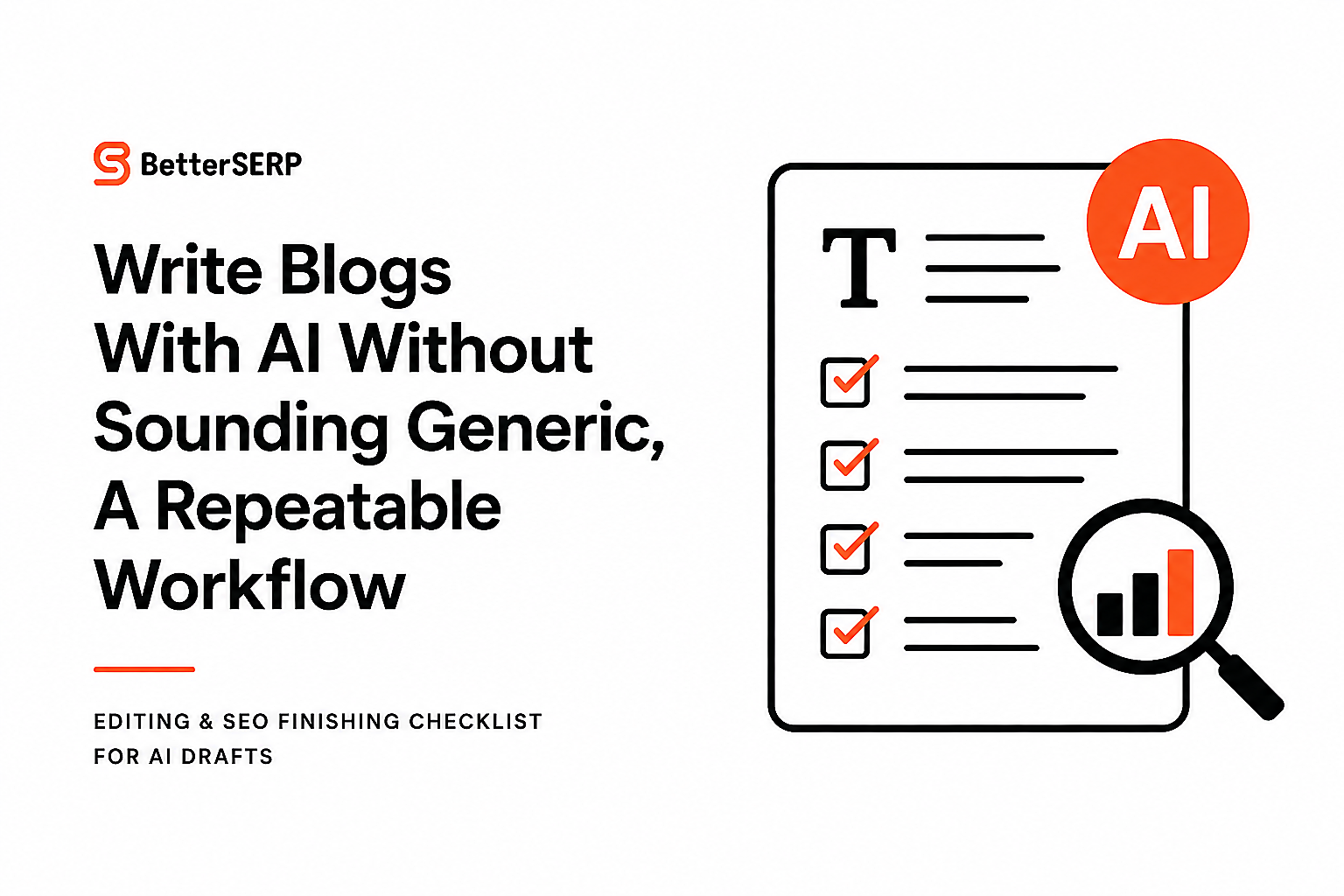
SEO-ready AI content needs a finishing checklist that covers snippet targeting, internal links, and intent alignment, because models tend to stop at “readable draft.”
On-page checklist (10 minutes per post)
- Title: states the outcome and matches intent; avoid clickbait.
- H1: close to the title; contains the main topic naturally.
- Headings: each H2 answers a distinct sub-intent; no duplicate headings.
- Intro: first sentence defines the topic; first paragraph sets the promise.
- Images: at least one supporting visual, descriptive alt text.
- Conclusion: summarizes action steps, not just “in summary” filler.
Snippet and PAA targeting without stuffing
To earn featured snippets and People Also Ask visibility, add 2 types of extractable blocks:
- Definition block: one sentence that can stand alone.
- Process block: a short numbered list (3 to 7 steps) that directly answers “how.”
Place these blocks immediately after the relevant heading. Do not repeat the same block elsewhere.
Internal linking rules that scale
Use a simple internal linking policy:
- Add 2 to 4 links to closely related posts.
- Link the first time a concept appears, not every time.
- Prefer descriptive anchors that match the destination’s purpose.
Natural related reads for this topic include ai for seo and a pragmatic take on ai blogging workflows.
Refresh cadence tied to signals (not vibes)
Refresh when one of these happens:
- Impressions rise but clicks lag: improve title, intro clarity, and snippet blocks.
- Ranking stalls on page 2: add missing subtopics and strengthen internal links.
- Conversions are low: add comparison tables, clearer CTAs, or better next steps.
Can AI blogs make money, a simple numbers-based roadmap to 1000 per month
AI-assisted blogs can make money when you treat content as an inventory system where traffic, conversion rate, and monetization method are planned upfront.
Model 1: Affiliate content (high intent, lower volume)
Affiliate earnings depend heavily on niche and offer, so instead of claiming universal RPMs, plan with your own assumptions:
- Inputs: monthly organic sessions to money pages, click-through to affiliate link, conversion rate on merchant site, commission per sale.
- AI accelerates: drafting supporting informational posts, comparison outlines, and refresh updates.
- Human must own: disclosures, real product experience, and accurate pros/cons.
Rule: do not publish “best X” claims unless you can justify criteria and keep them updated.
Model 2: Leads for services (steady, compounding)
For service businesses, the math is often simpler:
- Target: $1,000/month from leads
- Inputs to estimate: visitors → contact rate → close rate → average deal value
- Plan: publish clusters around problems you solve and include a clear next step on each page
What surprised our team was how often the bottleneck was not traffic, but unclear “next step” copy on otherwise solid informational posts.
Model 3: Ads and sponsorships (volume, consistency)
Ad revenue is mostly a function of sessions and geography, and it can fluctuate. If you pursue ads:
- Focus on consistent publishing and refresh cycles.
- Prioritize evergreen informational topics where updates are straightforward.
- Use AI to speed up drafts, but do not cut corners on originality and usefulness.
A realistic timeline framework (what to expect)
Instead of promising a universal timeframe, use milestones you can measure:
- Month 1: SOP built, 10 to 20 posts published, internal linking structure started.
- Months 2 to 3: refresh early posts based on impressions, expand missing subtopics.
- Months 4+: double down on topics that show traction, prune underperformers, improve conversion paths.
Responsible and legal use of AI for blog content
Responsible AI blogging is mostly about disclosure choices, copyright risk reduction, and making sure a human is accountable for claims.
Is it legal to publish AI-generated blog posts?
Publishing AI-assisted content is generally legal, but legality does not guarantee safety. The common risks are copyright (copying protected text), trademark misuse, and false claims. Risk reduction looks like this: do not prompt models to imitate specific living authors, do not paste competitor content into prompts, and run plagiarism checks if your workflow uses lots of scraped notes.
Do you need to disclose AI use?
Disclosure is usually a policy and trust decision, not a universal legal requirement. Practical options:
- No disclosure: acceptable for many teams if humans edit and verify, but keep internal documentation.
- Light disclosure: “This article was drafted with AI assistance and reviewed by an editor.”
- Full process disclosure: list how you verify facts and update the post.
Choose the option that matches your audience’s expectations and the sensitivity of the topic.
Ownership and originality basics (keep it simple)
AI outputs may not qualify for copyright protection in some jurisdictions without meaningful human authorship, and that can matter if you need enforceable IP. The practical approach: ensure a human editor contributes original structure, examples, and decisions, and keep drafts and edit history in your workflow documentation.
A minimal governance checklist for teams
- Maintain a shared “prompt and brief” library with approved constraints.
- Require a fact-check pass for every post that includes numbers, medical or financial claims, or legal guidance.
- Document sources used for each post.
- Set a refresh schedule and an owner for updates.
| Stage | Human responsibility | AI responsibility | Quality check to pass |
|---|---|---|---|
| Brief | Intent, audience, sources, angle | Clarifying questions, outline options | Sources list exists and gaps are named |
| Outline | Select best structure for SERP | H2/H3 draft with missing-info prompts | No duplicate headings; each H2 maps to a sub-intent |
| Draft | Section goals, constraints | Paragraph drafts, rewrites, FAQ drafts | No unsupported claims; minimal repetition |
| Edit | Truth, voice, usefulness | Rewrite for clarity, shorten, expand examples | 3-pass edit complete (structure, truth, voice) |
| SEO finish | Internal links, snippet blocks, publish settings | Meta description drafts, title variants | On-page checklist complete and refresh date set |
FAQ about writing blogs with AI
Will Google penalize me if I write blogs with ai?
Google focuses on content quality and usefulness rather than whether AI was used. The practical risk comes from thin, unhelpful pages or inaccurate claims, so use a sources-first approach and a human fact-check pass.
How do I stop AI from making up facts?
Provide trusted sources up front, instruct the model to say “not enough info” when a source is missing, and run a claim-by-claim verification pass that flags numbers, dates, and absolute statements.
What is the fastest workflow to write blogs with ai that still sound human?
Start with a one-page brief, generate a constrained outline, draft one section at a time, then do three edits: structure, truth, and voice. Add snippet-friendly blocks and internal links before publishing.
How many times should I use the keyword in an AI-written post?
Use the primary keyword where it fits naturally, typically in the title, early in the intro, one heading, and a few times in the body. Clarity and intent match matter more than repetition.
If you want to turn this workflow into a shared, repeatable SOP across a team, Better SERP provides AI workflow templates and standardized brief-to-publish checklists so your process stays consistent while you scale.
Read Next
View all
What Is SEO Automation, How It Works, And 3 Workflows You Can Copy
Learn what is seo automation, how it works (inputs → logic → outputs), what to automate safely, and 3 copyable workflows with a starter stack.
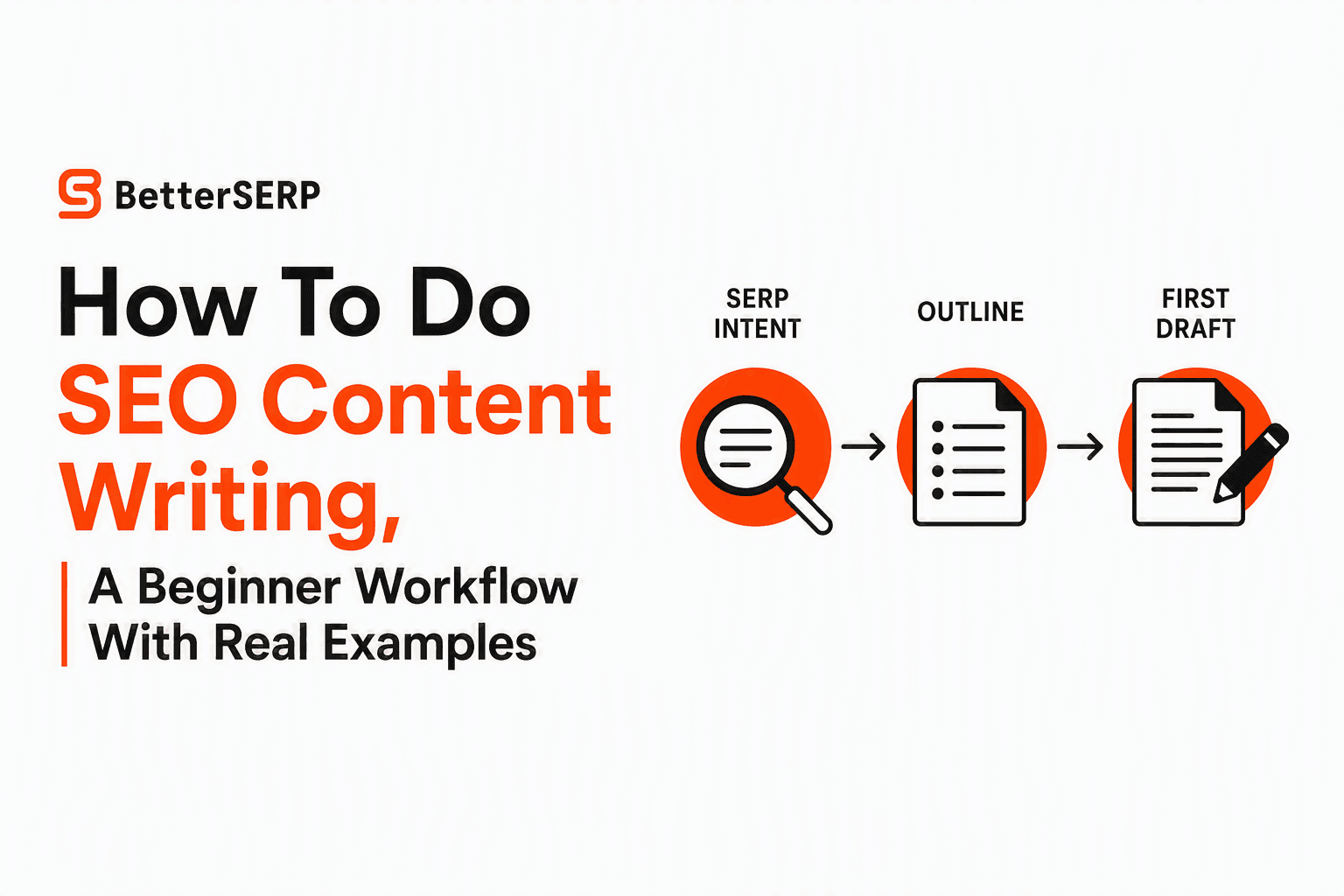
How To Do SEO Content Writing, A Beginner Workflow With Real Examples
Learn how to do seo content writing with a beginner workflow: SERP intent, outlines, drafts, a full example, and a 7-day practice plan.
1 Click Blog Post Explained, Template, Example, And When To Use It
Learn what a 1 click blog post is, when to use it, plus a copy-paste template, filled example, and an 80/20 SEO check before publishing.