
AI for SEO, The Practical Workflow From Research to Results
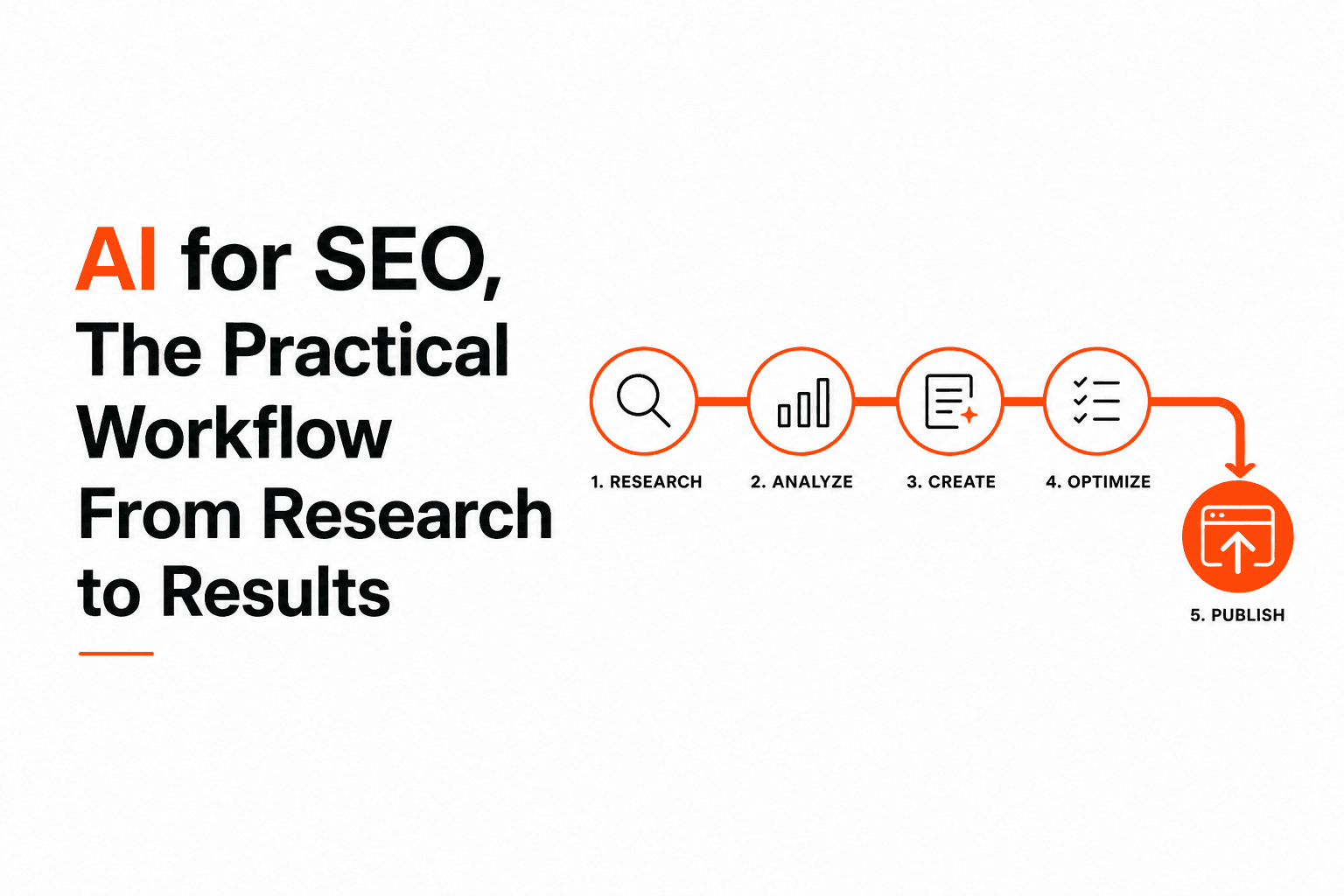
AI for SEO is no longer just “write a blog post faster” it is a repeatable workflow that connects research, briefs, drafts, on-page checks, internal links, and measurement so the content you publish is more likely to rank and earn visibility in AI-driven search.
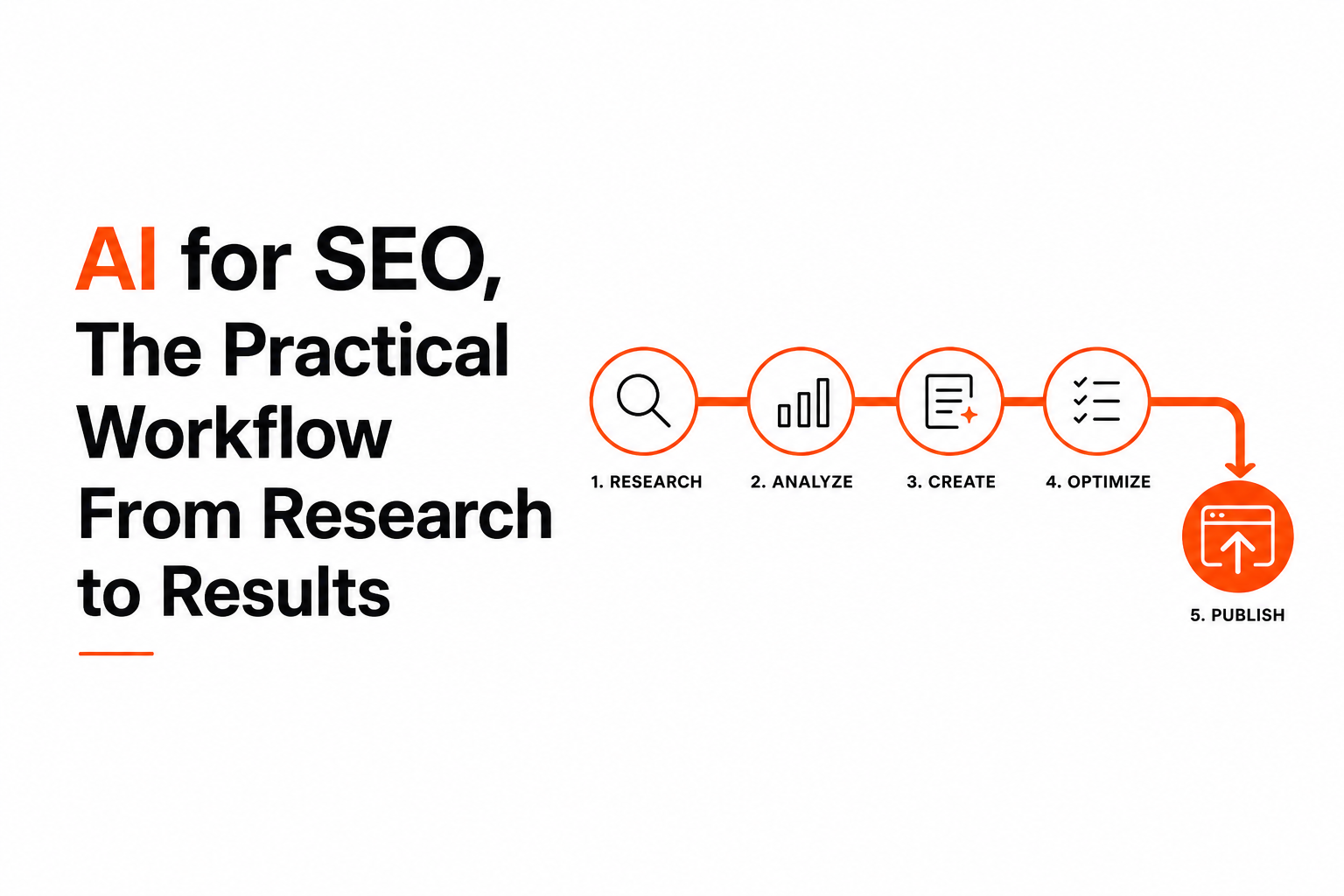
- Use AI for SEO as a workflow, not a single prompt: research → brief → draft → on-page → internal links → publish → measure.
- Apply a “30% rule” plus a QA checklist to prevent inaccuracies, duplication, and generic brand voice.
- Track outcomes with a simple KPI model: rankings and CTR from GSC, engagement from GA4, plus AI visibility signals (citations and mentions).
What AI For SEO Actually Means in 2026
In practice, ai for seo means using machine learning tools to speed up or standardize specific SEO jobs while keeping strategy, judgment, and accountability with humans. The easiest way to avoid disappointment is to separate what AI can reliably automate from what still needs a human owner.
A simple “jobs-to-be-done” map for AI in SEO
- Automate (high confidence): clustering keywords, drafting outlines, generating first drafts, rewriting for clarity, extracting entities and FAQs, formatting headings, creating meta titles/descriptions, building internal-link suggestions from a link list.
- Assist (medium confidence): search intent labeling, competitive gap summaries, SERP feature notes, schema suggestions, content refresh recommendations.
- Human-owned (non-negotiable): choosing which topics matter commercially, defining brand voice, fact-checking, legal/medical/financial review, final editorial judgment, and deciding what not to publish.
What AI cannot “automate” without risk
AI is weak at truth and novelty unless you feed it trustworthy inputs. It can confidently invent stats, misread sources, or produce a plausible but wrong explanation. It also tends to average out your voice and become commodity content if you do not enforce constraints like unique examples, first-party experience, and specific formatting rules.
The output you should expect from AI for SEO
Use this benchmark: AI should reduce time spent on repetitive drafting and formatting by 30% to 70%, but it should not remove the need for a review loop. If you are relying on AI to decide the strategy or publish without checks, you are not doing ai for seo, you are outsourcing your brand risk.
The AI For SEO Workflow From Keyword to Publish
This is an end-to-end workflow map you can reuse for every article. The goal is consistency: every piece goes through the same gates so quality improves over time, not just output volume.
Step 1: Keyword research and clustering (template)
Inputs: seed topics, customer pain points, GSC queries, and a list of priority services/products. Output: clusters with one primary query and supporting queries.
Copyable clustering template (paste into your doc or sheet):
- Cluster name: (topic)
- Primary keyword: (highest intent or best fit)
- Supporting keywords: (3 to 8)
- Search intent: informational / commercial / transactional
- Likely SERP format: listicle / guide / comparison / how-to
- Internal link targets: (2 to 5 URLs)
- Proof assets: (case notes, screenshots, data sources)
When we tested clustering by “intent first” (grouping by what the searcher is trying to do, not just synonyms), our team spent less time rewriting intros and headings later because the outline matched the SERP format from the start.
Step 2: Build a one-page content brief (template)
Your brief is the governance layer. AI performs best when the brief is strict and specific.
Copyable brief template:
- Primary keyword: ai for seo (or your chosen keyword)
- Audience: who this is for, what they already know
- Goal: what the reader should do or understand by the end
- Angle: what makes this different from top results
- Required sections: list H2s and must-include points
- Must-include entities: tools, standards, concepts (example: Google Search Console, GA4)
- Internal links to include: URLs + preferred anchor text
- Evidence rules: cite sources for stats, no invented numbers
- Voice rules: tone, reading level, formatting constraints
Step 3: Draft with constraints (prompt pattern)
Instead of a single “write an article” prompt, use a two-pass pattern: (1) outline, (2) section drafts. This reduces repetition and makes QA easier.
- Prompt A (outline): “Create an outline for [keyword] that matches [SERP format]. Include H2/H3s, a checklist, and a measurement section. Avoid buzzwords. Include places for internal links.”
- Prompt B (section draft): “Draft H2 section [name]. Use the brief constraints. Add one example and one checklist. Do not add stats unless cited.”
Step 4: On-page SEO pass (checklist)
Run a fast on-page pass before you polish prose. Here is a concrete checklist that works for most informational posts:
- Title: matches intent, includes primary keyword naturally
- Intro: states problem and outcome in 2 to 3 sentences
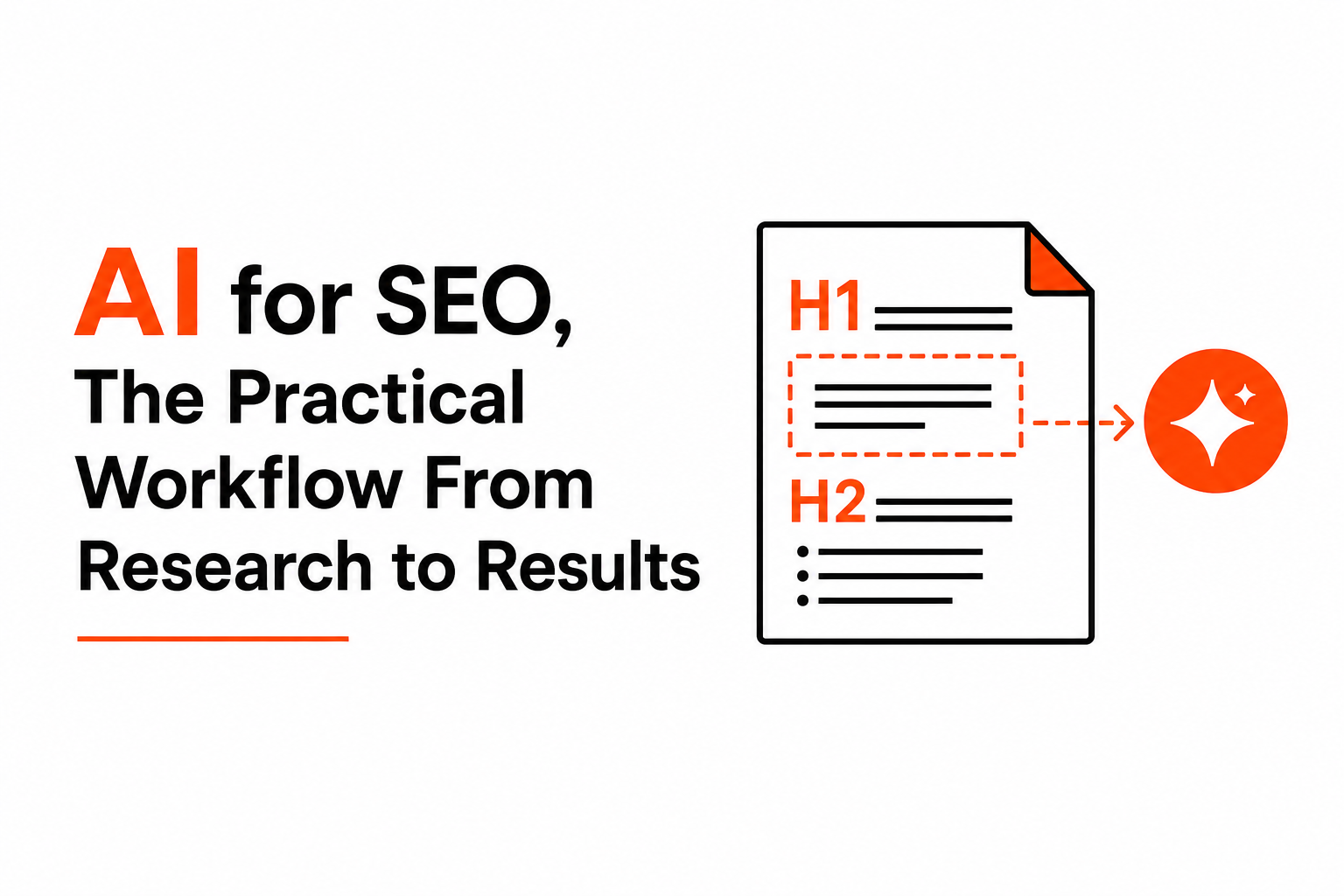
- Headings: one H1, logical H2 hierarchy, no duplicate H2s
- Keyword use: primary in first 100 words, one H2, and sprinkled where relevant (no stuffing)
- Entities: include 5 to 10 related entities (tools, concepts) that appear in top SERPs
- Snippets: add at least one short definition paragraph and one bulleted list
- Meta title/description: written for CTR, not just keywords
Step 5: Internal linking (rules you can automate)
Internal links are where ai for seo can help without risking accuracy. Use rules instead of “add some links”:
- Link from the first relevant mention, not the last.
- Use descriptive anchors that match the destination’s intent.
- Add 2 to 5 internal links per post, prioritizing money pages and related guides.
- Avoid repeating the exact same anchor across many posts.
For deeper background on automation concepts, see what is seo automation. If you want a drafting workflow that aligns with on-page rules, this guide on how to write seo friendly article is a useful companion.
The 30% Rule for AI Content and a QA Checklist
The “30% rule” is a practical governance constraint: at least 30% of the final article should be meaningfully improved by a human editor. That does not mean “change words” it means add original structure, first-hand context, clearer examples, better internal links, or corrected claims.
Why the 30% rule exists
- Originality: AI drafts often converge on the same phrasing and examples as everyone else.
- Accuracy: the highest risk is confident misinformation.
- Brand voice: without edits, everything starts to sound the same across clients or categories.
SEO-specific QA checklist (copyable)
Use this checklist as a final gate before publish:
- Fact check: verify every claim that includes numbers, dates, or “best” statements. If you cannot verify, rewrite as a non-quantified statement or remove.
- Source hygiene: cite primary sources when possible. For SEO basics, Google documentation is a safe default (example: Google Search Central documentation).
- Search intent match: compare your headings to the top 5 results. If they all include “steps” and you wrote a “definition-only” piece, adjust.
- Thin sections: any H2 under ~120 words usually needs an example, a list, or a clear decision rule.
- Duplicate risk: remove boilerplate intros, generic “in conclusion” endings, and repeated definitions.
- Internal links: at least 2, and each one must have a reason (next step, prerequisite, deeper dive).
- Snippet readiness: include one 40 to 60 word definition and one short checklist.
A quick originality upgrade pattern
If a section feels generic, apply one of these upgrades:
- Add a constraint: “Do X only if Y is true” (example: only target a keyword if you have a relevant internal link target and a unique example).
- Add a mini-example: one paragraph that shows how a decision changes the output.
- Add a table: turn vague guidance into a selection matrix.
SEO for AI Search, GEO and AEO Without the Buzzwords
AI-driven search experiences still reward the same fundamentals: clear structure, accurate information, and pages that answer the query better than alternatives. The difference is that you are also optimizing for “extractability” so systems can quote, summarize, or cite your page.
Map classic SEO actions to AI visibility outcomes
- Clear definitions near the top → easier for summaries to pull a correct answer.
- Descriptive headings and lists → better extraction for step-by-step responses.
- Entity coverage (tools, standards, terms) → better topical clarity and fewer hallucinated gaps.
- Unique examples and constraints → more quotable content, less generic paraphrase.
One-page “AI visibility” edit you can do in 15 minutes
- Add a 50-word definition block after the intro.
- Add a “Checklist” H3 with 5 to 8 bullets.
- Add 2 internal links to supporting guides and 1 link to a primary source.
- Rewrite one section to include a concrete decision rule (if/then) and a short example.
We initially assumed adding more keywords would improve AI visibility, but after reviewing pages that earned more citations, the pattern was clear: structured answers and specific examples mattered more than repeating the phrase ai for seo.
If you want a deeper explanation of how these disciplines overlap without confusing them, this guide on ai and seo is a helpful reference.
How to Measure Results, Rankings, CTR, and AI Visibility
Measurement is where ai for seo workflows either become compounding systems or content mills. You need a small set of KPIs you can review weekly and monthly, tied to actions you can actually take.
A simple KPI model (weekly and monthly)
- Weekly (diagnostic): impressions, clicks, CTR, average position for the page and its primary query (Google Search Console).
- Monthly (outcome): number of queries in top 3 and top 10, total organic clicks, assisted conversions or engaged sessions (GA4), internal link clicks if you track them.
- AI visibility (monthly): track whether the page is cited or referenced in AI summaries for target queries, and whether branded mentions increase. Keep it simple: a yes/no log per priority query plus notes.
Reporting cadence that prevents overreacting
- Day 1 to 14: check indexing, obvious CTR issues (title/meta), and technical problems.
- Week 3 to 6: optimize sections with high impressions but low CTR, expand thin parts, add internal links.
- Month 2 to 3: decide: refresh, consolidate, or build supporting articles in the cluster.
A practical “refresh trigger” list
- High impressions, CTR below your site average by 20% or more.
- Ranking positions 8 to 20 for the primary query for 4+ weeks.
- The SERP format changed (more lists, more tools, more comparisons).
- Competitors added a clearer checklist or better examples.
For more hands-on guidance on building search engine optimized content, use that page as a reference when you do your first refresh cycle.
A Simple Tool Selection Matrix Including a Free Starter Stack
The best ai for seo stack depends on the job you are trying to automate. Start with a free or low-cost setup, then upgrade only when time savings and consistency are proven.
Tool selection criteria (score each 1 to 5)
- Reliability: does it stay within constraints and avoid made-up facts?
- Workflow fit: does it support briefs, templates, and repeatable steps?
- Integration: can it connect to your CMS, docs, or reporting?
- Governance: can you enforce brand voice and review gates?
- Cost to scale: what happens when you go from 5 to 50 articles/month?
Free starter stack (good enough to prove the workflow)
- Google Search Console: queries, impressions, CTR, indexing checks.
- GA4: engagement and conversion proxies.
- A spreadsheet: keyword clusters, brief templates, QA checklist tracking.
- An AI writing assistant: for outlines and first drafts, used with constraints and QA.
Upgrade triggers
- You cannot keep briefs and brand rules consistent across multiple sites or clients.
- Publishing and formatting is taking longer than drafting.
- Internal linking is inconsistent or forgotten.
- Reporting is manual and you miss refresh opportunities.
Common Risks and Governance to Avoid Commodity Content
Scaling with ai for seo without governance usually leads to one of five failures: inaccurate claims, duplicated angles, off-brand voice, privacy issues, or publishing content that does not match intent.
Risk 1: Accuracy and “confident wrong” statements
- Guardrail: ban uncited statistics and require a source link for any number.
- Process: one editor owns fact-checking, even if AI drafted it.
Risk 2: Duplication across your own site
- Guardrail: maintain a topic map and assign one primary page per intent.
- Process: if a new draft overlaps 60%+ with an existing URL, refresh or consolidate instead of publishing a new page.
Risk 3: Generic brand voice
- Guardrail: a short “voice card” per brand: words to use, words to avoid, formatting rules, and 2 example paragraphs.
- Process: require one “unique element” per post: a decision rule, a mini-case from your own process, or a custom checklist.
Risk 4: Privacy and sensitive data
- Guardrail: never paste client PII, customer lists, or private analytics exports into public AI tools.
- Process: create a redaction checklist for briefs and examples.
Risk 5: Publishing without a review gate
In our experience working with teams trying to scale content fast, the lowest-effort fix that prevents most problems is a two-step publish gate: one person signs off on accuracy and intent, another signs off on brand voice and internal links.
| Workflow step | What AI can do | Human check | Output artifact |
|---|---|---|---|
| Research and clustering | Group keywords, suggest intent, summarize SERP patterns | Pick priorities based on business value | Cluster sheet |
| Brief | Draft outline options and questions to answer | Set angle, evidence rules, and internal link targets | One-page brief |
| Draft | Write first draft with headings, lists, and FAQs | Add unique examples, remove fluff, verify facts | Draft v1 |
| On-page and links | Suggest meta tags and internal links from a list | Ensure intent match and link relevance | Publish-ready page |
| Measurement | Summarize GSC/GA4 trends and propose refresh tasks | Decide what to update and what to build next | Monthly report |
FAQ
Is AI for SEO the same as using AI to write blog posts?
No. AI for SEO is broader: it includes research, briefs, drafting, on-page checks, internal linking, and measurement. Writing is only one step, and it is the step that needs the most human QA.
How many times should I use the keyword ai for seo on a page?
Use it naturally: in the intro, at least one H2, and a few additional times where it fits. Prioritize intent match and clarity over repetition, and add related entities and examples to strengthen topical coverage.
Will AI-generated content rank in Google?
It can, if it is helpful, accurate, and matches search intent. The bigger risk is publishing generic or incorrect content. A strict brief plus a QA checklist is what makes AI-assisted content competitive.
What is the fastest way to improve AI-assisted content quality?
Enforce a governance rule like the 30% rule, ban uncited statistics, and require at least one unique element per post (a decision rule, a mini-example, or a custom checklist). Those three changes usually reduce “commodity” output quickly.
If you want to operationalize this workflow without copy-pasting between tools, Better SERP provides AI workflow templates designed for SEO agencies so you can go from keyword to publish-ready drafts with built-in structure, checks, and scheduling.