
1 Click Blog Post Explained, Template, Example, And When To Use It
Learn what a 1 click blog post is, when to use it, plus a copy-paste template, filled example, and an 80/20 SEO check before publishing.
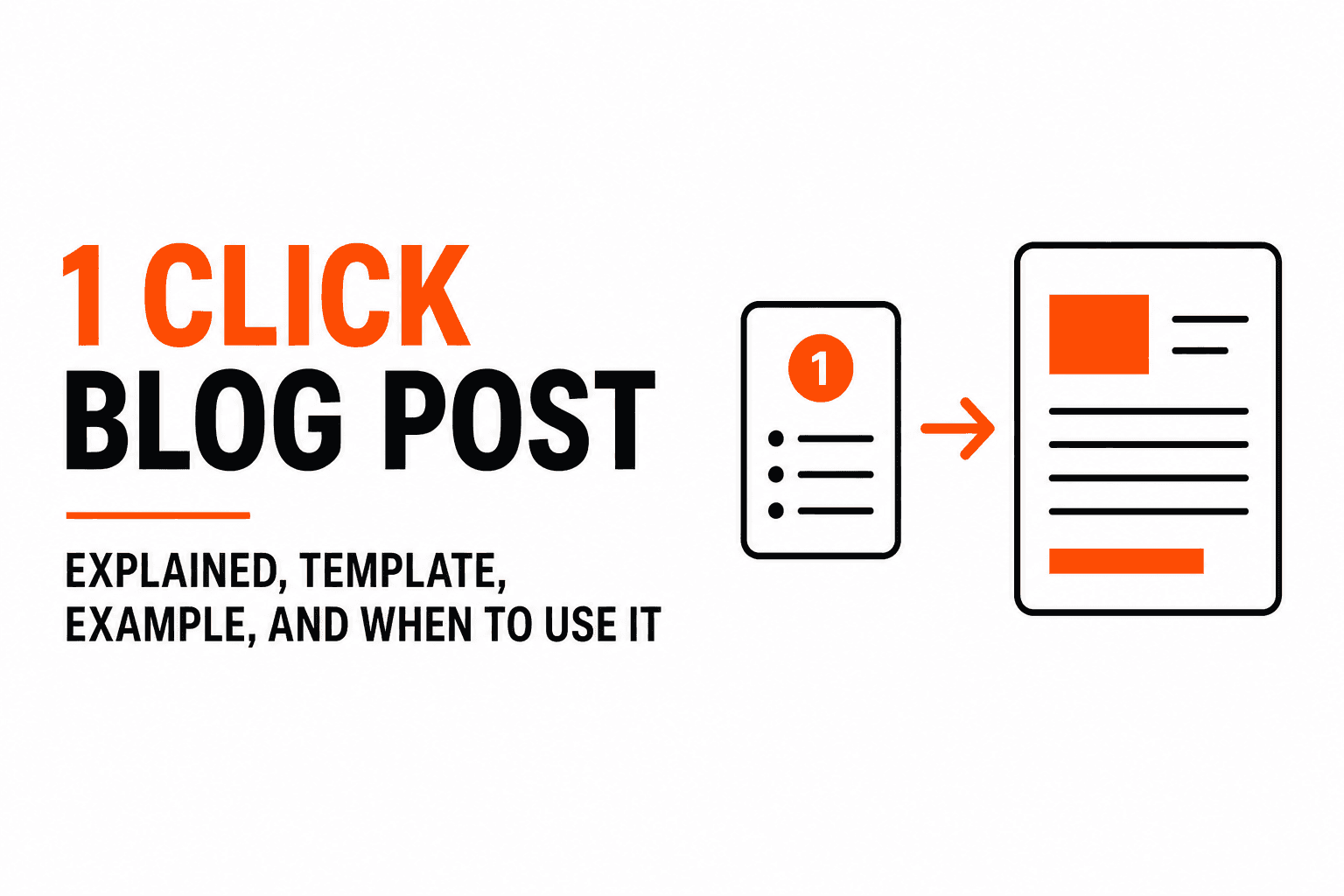
A 1 click blog post is a workflow where you give an AI a single, structured input (usually a keyword plus a few rules) and it generates a complete draft with a title, headings, and body content in one run.
- A 1 click blog post works best when the topic is standard, repeatable, and intent is clear, and it fails when the topic requires original reporting or nuanced claims.
- Use a fixed template (inputs and structure) so the “one click” output is predictable enough to edit quickly.
- Before you publish, run an 80/20 check: intent match, title/H1 alignment, internal links, and a quick originality and fact-check pass.
What a 1 click blog post actually means and when it makes sense
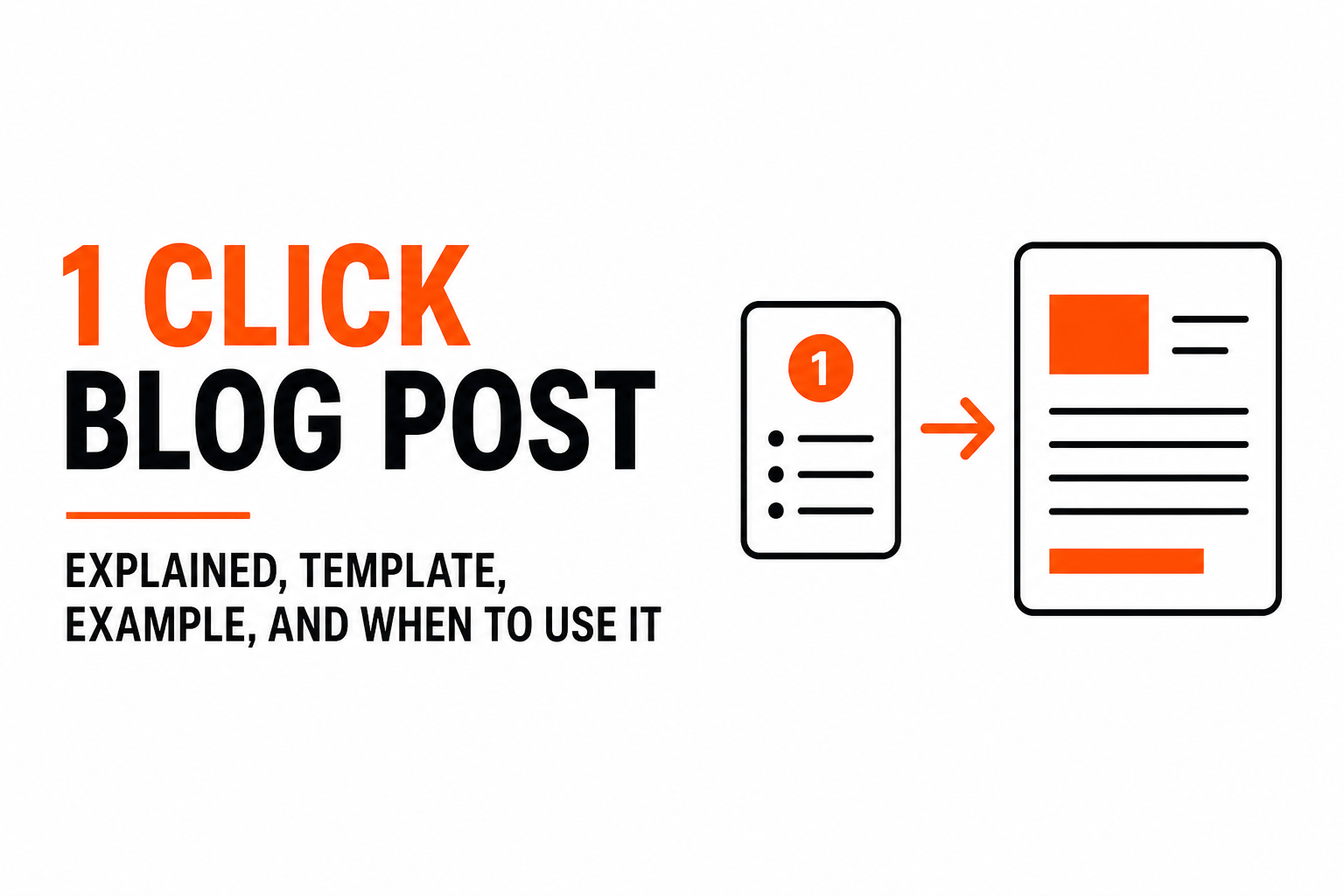
A 1 click blog post is “one request in, full draft out,” meaning one submission produces a complete article draft with a headline, an outline, and section copy ready for editing.
What “one input” usually includes
In practice, “one click” does not mean “zero thinking,” it means you prepared a reusable input once and reuse it. A solid one-input spec typically bundles:
- Target keyword + intent: e.g., informational, comparison, how-to.
- Audience and tone: who it is for and how it should sound.
- Constraints: what to avoid (unsupported claims, medical/legal advice, jargon).
- Structure rules: H1, H2s, bullets, and a short conclusion.
- On-page SEO basics: include the keyword in title/H1, but avoid stuffing.
When a 1 click blog post is a good fit
A 1 click blog post makes the most sense when the content can follow a repeatable pattern and does not require new data collection. Use it for:
- Glossary-style explainers: definitions, workflows, checklists.
- Standard “how it works” posts: when steps are known and verifiable.
- Long-tail SEO topics: many pages with similar structure, different keywords.
- Content refresh drafts: rewriting and reorganizing an existing page you already trust.
When it is the wrong tool
A 1 click blog post is risky when accuracy or originality must come from primary work. Avoid relying on one-click drafts for:
- Claims that need citations: stats, benchmarks, legal interpretations, medical guidance.
- Original reporting: interviews, surveys, product testing, pricing research.
- Highly regulated or sensitive topics: where hallucinations create real harm.
In our experience working with agency teams, the biggest time-saver is not “writing faster,” it is “editing less,” and that only happens when the input spec is consistent and the topic is well-bounded.
Use a copy-paste template and filled example
A repeatable template turns a 1 click blog post from a gimmick into a controllable workflow because the output becomes predictable enough to QA quickly.
Copy-paste prompt template (one input)
Copy and paste the template below into your AI tool of choice, fill the brackets, and submit once.
Write an SEO blog post.

PRIMARY KEYWORD: [keyword]
SEARCH INTENT: [informational/comparison/how-to]
AUDIENCE: [who is this for]
TONE: [approachable, expert, etc.]
WHAT THE READER SHOULD ACHIEVE: [outcome]

REQUIREMENTS:
- Provide a clear definition in the first paragraph.
- Use H1 + 4 H2 sections with short H3s where helpful.
- Include one practical checklist the reader can follow.
- Include 1 simple example (realistic, not exaggerated).
- Avoid unsupported statistics. If you mention a number, explain how to verify it.
- Add a short conclusion with next steps.

STRUCTURE:
H1: [suggest]
Intro: 3 to 5 sentences
H2 #1: Definition and when to use
H2 #2: Step-by-step workflow
H2 #3: Common mistakes and fixes
H2 #4: Quick quality checklist
Conclusion: 4 to 6 sentences
Filled example (so you can see the output target)
Here is the same template filled in for a realistic topic. You can reuse the pattern for your own keywords.
PRIMARY KEYWORD: 1 click blog post
SEARCH INTENT: informational
AUDIENCE: small SEO teams and agency coordinators
TONE: educational, jargon-light
WHAT THE READER SHOULD ACHIEVE: generate a fast draft and know exactly what to edit before publishing
What a “good” one-click draft should look like
Use these acceptance criteria to decide if the draft is worth editing or should be regenerated:
- Structure: clear H2 hierarchy, no duplicated headings, no rambling sections.
- Intent match: answers “what it is / when to use it / how to make it publishable.”
- Specificity: includes at least one checklist, one example, and concrete do/do-not guidance.
- Claims: avoids “studies show” language without a source you can verify.
When we tested template-based prompts versus freeform prompts, the template approach reduced rewrites because the AI stopped inventing extra sections and stayed inside the brief.
Apply the 80 20 SEO check before you publish
An 80/20 SEO check is a short set of edits that improves relevance and readability without turning a 1 click blog post into a full rewrite.
The 80/20 checklist (do these in order)
- Confirm search intent in one sentence: write what the searcher wants and ensure the intro and H2s deliver it.
- Fix the title and H1 alignment: both should promise the same outcome using near-identical phrasing.
- Make headings scannable: each H2 should answer a specific sub-question; remove filler headings.
- Add 2 to 4 internal links: link only where it genuinely helps the reader continue the journey.
- Add one piece of original insight: a short observation, a decision rule, or a tiny workflow note based on your real process.
Internal links you can add without overthinking
If you have relevant supporting guides, insert internal links at the first natural mention. For example, if you discuss AI-assisted workflows, link to ai blogging. If you need a repeatable on-page process, reference how to do seo for blog. When you talk about writing structure, write seo friendly article can be a natural next read, and for broader guidelines, how to do seo content writing fits well.
A minimal “SEO not spam” rule
Keep the primary keyword present but not repetitive: a 1 click blog post should read like a human editor wrote it, so prefer clarity over forced repetition. If a sentence sounds unnatural when read aloud, rewrite it even if it contains the keyword.
Turn fast drafts into safe, publish-ready posts
A publish-ready draft is a draft that has been checked for accuracy, originality, and credibility signals so it does not create thin, risky content at scale.
Fact-checking in 7 minutes (lightweight but real)
- Highlight every claim that could be false: numbers, “best” statements, tool capabilities, dates.
- Verify 3 key statements: open official docs, standards bodies, or your own source of truth.
- Remove what you cannot verify: replace with a mechanism, criterion, or “how to validate” instruction.
If you need a reference for how automation workflows are typically framed, you can compare your process to the definition and examples in what is seo automation.
Originality and “thin content” guardrails
To keep a 1 click blog post from becoming a near-duplicate of everything else on the web, add at least one of the following:
- A decision rule: “Use one-click drafts when X is true; do not when Y is true.”
- A mini example: a realistic scenario with inputs and the edit steps you took.
- A checklist with pass fail criteria: something a reader can actually apply.
What surprised our team was how often “originality” came from tiny edits, like adding a single acceptance test for the draft, rather than adding lots of new paragraphs.
Quick E-E-A-T routine (lightweight)
- Experience: add one line on how you run this in real life, without exaggeration.
- Expertise: define terms plainly and avoid claims you cannot support.
- Authoritativeness: link out only to reputable standards or official docs when needed.
- Trust: remove speculative sections and ensure the advice fits the reader context.
| Checkpoint | What “pass” looks like | Fast fix if it fails |
|---|---|---|
| Intent match | Intro and H2s answer the same question the title promises | Rewrite title, reorder headings, cut off-topic sections |
| Structure | One H1, clear H2s, bullets where appropriate | Merge repetitive H2s, shorten long paragraphs |
| Internal links | 2 to 4 links that genuinely help the reader | Add links at first natural mention, remove forced links |
| Claims | No unverifiable stats, no “studies show” without sources | Delete or replace with criteria and how to verify |
| Original insight | At least one unique rule, example, or checklist | Add a decision rule and a small, realistic scenario |
FAQ
Is a 1 click blog post the same as auto-publishing AI content?
A 1 click blog post describes how the draft is generated in one run; auto-publishing describes what happens after. You can generate in one click and still keep a human QA step before anything goes live.
How long should it take to edit a one-click draft?
For straightforward informational topics, a practical target is one focused edit pass: align intent, fix headings, add internal links, and run a quick claim check. If you are rewriting most paragraphs, the input template likely needs tightening.
How many times should I use the keyword in a 1 click blog post?
Use the keyword where it reads naturally: title, H1, and a few places in the body. Prioritize clarity, because awkward repetition can hurt readability and trust.
What is the biggest risk with one-click content?
The biggest risk is publishing unverifiable claims or thin, generic copy at scale. A simple guardrail is to remove anything you cannot check and add one original decision rule or example per post.
If you want a repeatable way to produce and manage 1 click blog post workflows across multiple sites, Better SERP offers AI workflow templates built for SEO agencies so your team can standardize inputs, generate drafts faster, and keep the editing checklist consistent.
Read Next
View all
Artificial Intelligence SEO, A Practical Workflow You Can Repeat From Research to Results
Artificial intelligence seo in 2026, a tool-agnostic workflow for research, drafting, QA, AI Overviews optimization, and measurement.

AI And SEO, What’s The Difference And How To Use Both Without Losing Quality
Learn ai and seo differences, where AI helps most, and a repeatable workflow with prompts, QA, and tool stacks to keep quality high.

AI Blogging Explained, A Practical Workflow That Still Sounds Human
Learn ai blogging with a repeatable workflow, copy-paste prompts, and a publish-gate checklist to create SEO-ready posts without losing brand voice.