
How To Do SEO Content Writing, A Beginner Workflow With Real Examples
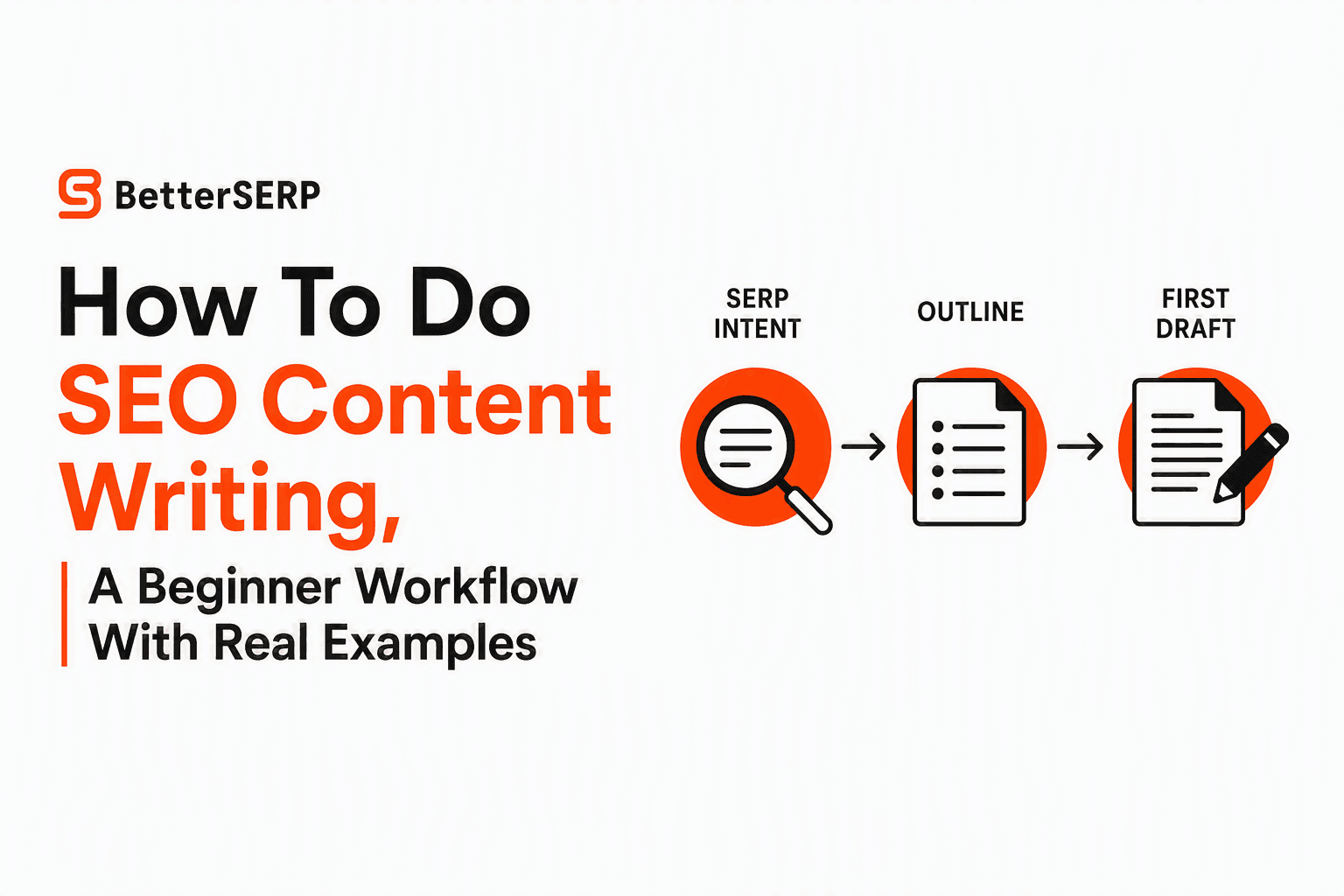
How to do seo content writing comes down to one repeatable skill: match what searchers want (intent) and deliver it clearly, fast, and credibly without keyword stuffing.
- Start with the SERP: identify the dominant intent, the common angles, and the content format Google is rewarding.
- Use a simple brief → outline → draft workflow so the keyword drives structure, not awkward repetition.
- Edit for scan-ability and trust: short paragraphs, proof, internal links, and clear next steps.
What SEO Content Writing Actually Means
SEO content writing is writing that satisfies a real reader goal while making it easy for search engines to understand the topic, structure, and relevance of the page.
The pain beginners run into is predictable: you either write something helpful that never ranks, or you chase rankings and end up with stiff, repetitive text. The consequences show up as low clicks (even if you rank), high bounce rates, and pages that do not earn links or get cited.
A plain-English definition you can use as a checklist
For day-to-day work, treat SEO content writing as a 3-part promise:
- Intent match: the page answers the query the way most searchers expect (format, depth, angle).
- Content clarity: headings and sections make the answer easy to skim and extract.
- Search understanding: the page uses consistent terminology, internal links, and on-page signals so a crawler can categorize it correctly.
What changes when you write for both people and search
You do not need a “secret” writing style. You need a workflow that produces predictable on-page signals:
- One primary keyword (topic) and a small set of secondary terms (subtopics and wording variants).
- A heading hierarchy that mirrors the questions people ask (H2 for major steps, H3 for details).
- Evidence and trust signals: sources where appropriate, author experience, and concrete examples.
- Useful navigation: internal links to next steps, definitions, and related guides.
Beginner benchmark: what “good” looks like
When we review early drafts, our team uses three quick criteria before we touch anything else:
- Could a reader get the core answer in under 15 seconds of skimming? (If not, tighten the intro and H2 openings.)
- Does each section earn its space? (If a paragraph does not add a new step, example, or criterion, cut it.)
- Is the keyword serving structure, not stuffing? (If you can remove a sentence and the meaning stays identical, it is probably fluff.)
How To Read The SERP And Match Search Intent
Reading the SERP before you draft is the fastest way to understand which content format and depth level Google is currently rewarding for a keyword.
Beginners often skip this and write the page they wish existed. The outcome is a mismatch: you publish a long tutorial when the SERP wants a checklist, or you publish a definition when the SERP wants examples and steps.
A 10-minute SERP inspection workflow
- Search the exact keyword in an incognito window and note the top 5 organic results.
- Label the dominant intent: informational (learn), commercial (compare), transactional (buy), navigational (brand/site).
- Record the dominant format you see most often: “how-to”, list, template, glossary, tool page, or product category.
- Extract the repeated subtopics from H2s and table-of-contents blocks.
- Note the credibility patterns: do results cite sources, include screenshots, show real examples, or mention tools?
Intent mapping: a simple scorecard
Use this scorecard to decide what to build:
- If 3+ results are step-by-step guides, your page should be a guide with steps, not a short definition.
- If 3+ results have templates/examples, add a worked example or copyable framework.
- If results include “best”, “top”, or comparisons, searchers want options and decision criteria.
- If results are short and snackable, keep your answer tight and add expansion only where it clarifies.
What to do with “People also ask” and autosuggest
“People also ask” questions are free subsection ideas, but you should use them selectively. A practical rule: include a PAA question only if answering it helps complete your main workflow. Otherwise, you dilute the page.
For this topic, you might pull questions like “Is SEO content writing just keyword stuffing?” or “How many keywords should I use?” and turn them into H3 sections or FAQ items.
One external reference worth using (without over-citing)
For beginners who want an official baseline, Google’s own guidance on helpful, people-first content is a useful north star, especially around avoiding content made primarily for search engines. You can skim it here: Creating helpful, reliable, people-first content.
How To Do SEO Content Writing With One Keyword Into A Brief, Outline, And Draft
How to do seo content writing reliably is to convert a keyword into a one-page brief, then an outline, then a draft that answers intent section by section.
This is the core problem beginners face: a blank document invites rambling. A brief and outline turn writing into assembly, so you can focus on clarity.
Step 1: Build a one-page content brief (copyable template)
Paste this into your doc and fill it out in 10 to 15 minutes:
- Primary keyword: (exact phrase)
- Search intent: informational / commercial / transactional / navigational
- Audience: who is this for and what do they already know?
- Promise: what will the reader be able to do in 30 minutes after reading?
- Must-include sections: 4 to 7 H2s based on SERP patterns
- Secondary terms: 6 to 12 related phrases (subtopics, synonyms, common questions)
- Proof points to add: examples, screenshots, cited sources, tools, checklists
- Internal links to include: 2 to 5 relevant pages
- CTA / next step: what should they do after finishing?
Step 2: Turn the brief into a ranking-friendly outline
A practical outline rule: each H2 should solve one “mini problem” on the way to the final outcome. If you cannot write a one-sentence outcome for the H2, it is probably not a real section.
Example outline skeleton:
- H2: Define the concept and the goal (reader + search)
- H2: Show how to validate intent in the SERP
- H2: Provide the workflow (brief, outline, draft)
- H2: Give a worked example end-to-end
- H2: Show editing and trust improvements
- H2: Explain AI use and quality checks
- H2: Give a practice plan to repeat the process
Step 3: Draft section by section with “answer first” paragraphs
To keep your writing extractable (good for snippets and AI summaries), use this micro-structure inside each section:
- First sentence: the direct answer or key claim.
- Next 2 to 4 sentences: how it works, what to do, or why it matters.
- Then: a checklist, example, or criteria list.
In our experience working with new writers, the biggest jump in quality happens when each H2 starts with a clear “what you should do” statement, not background.
Step 4: Place keywords naturally (a beginner-safe rule)
You do not need a specific density. You do need coverage. Use this rule instead:
- Primary keyword: include in the title, one H2 if it fits, the intro, and a few places where it reads naturally.
- Secondary terms: include where they belong as subtopics. If a term feels forced, the subtopic might not be needed.
- Synonyms and variations: use them to keep prose human, not to “trick” search engines.
See A Complete SEO Content Writing Example
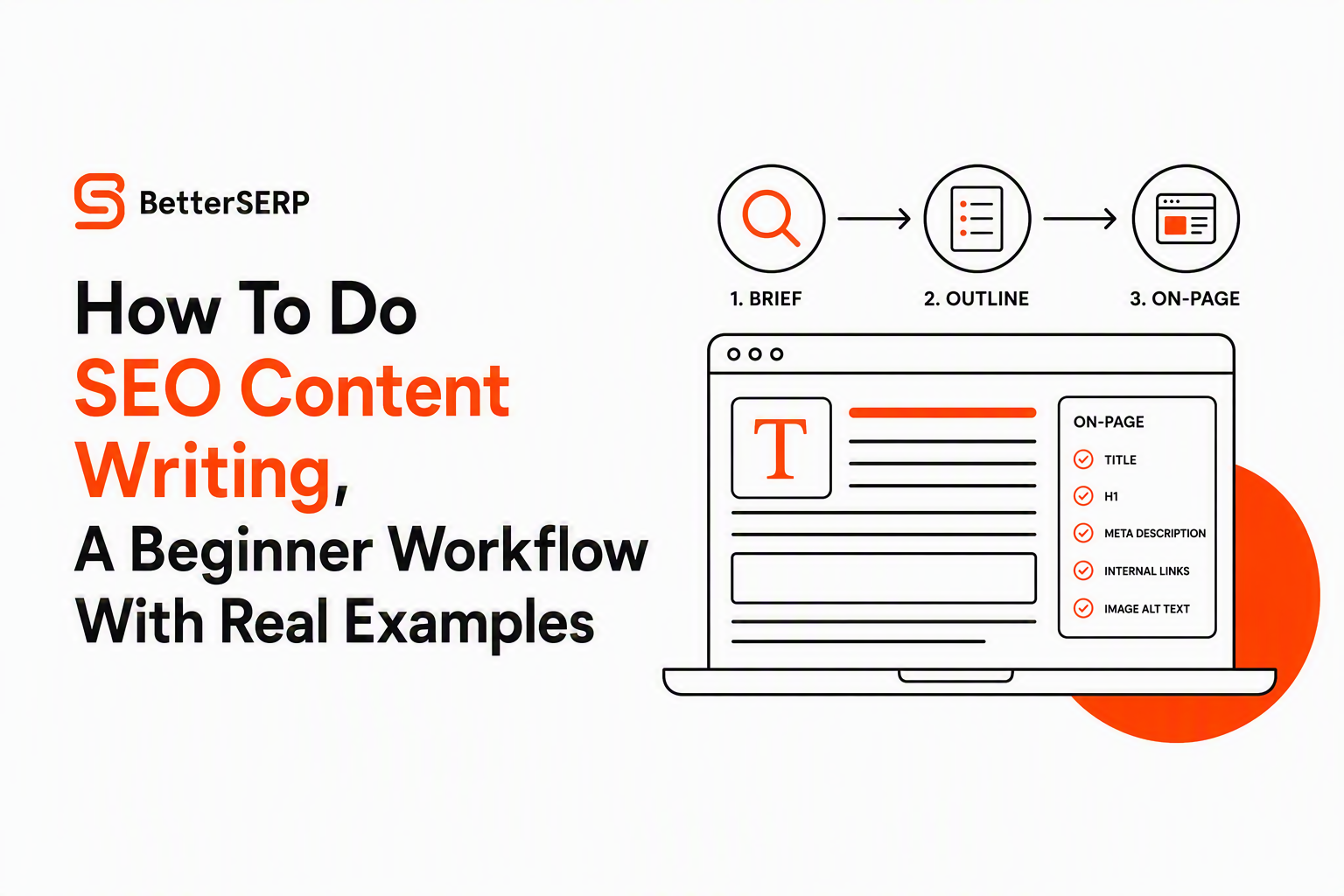
A complete example makes how to do seo content writing feel concrete because you can see the keyword, intent, outline, and on-page elements working together.
Example inputs
- Primary keyword: how to do seo content writing
- Intent: informational, beginner workflow
- Audience: new marketers, founders, and junior writers
- Promise: turn one keyword into a brief, outline, and first draft in under 60 minutes
- Secondary terms (sample): search intent, SERP analysis, outline template, on-page SEO, meta description, internal links, keyword stuffing, readability
Example brief (filled)
- Angle: workflow-first, no stuffing, one worked example
- Must-include sections: definition, SERP reading, brief-to-draft workflow, example, editing, AI guidance, practice plan
- Proof points: show a sample title tag, meta description, URL slug, and a draft excerpt
Example outline (H2s and H3s)
- H2: What it means (goal: readers + search)
- H2: Read the SERP (intent + format)
- H2: Workflow (brief, outline, draft)
- H2: Full example (inputs, outline, excerpt, title/meta/slug)
- H2: Edit for readability and trust
- H2: AI support and quality checks
- H2: 7-day practice plan
Example on-page elements
- Title tag: How To Do SEO Content Writing: Beginner Workflow + Example
- Meta description: Learn how to do seo content writing with a step-by-step workflow: read the SERP, build a brief, outline fast, and edit for rankings.
- URL slug: /how-to-do-seo-content-writing
Draft excerpt (showing answer-first structure)
Section excerpt:
SEO content writing works best when each section answers one specific reader question. For “how to do seo content writing,” readers want a workflow they can repeat, not a theory lesson. Start by scanning the top results to see whether Google prefers tutorials, templates, or lists, then mirror that format while improving clarity and examples.
- Do: open each H2 with the key takeaway sentence.
- Do: add a checklist or mini example under the explanation.
- Don’t: repeat the keyword in every paragraph.
Make The Draft Readable, Credible, And Easy To Scan
Readable SEO drafts win because readers can skim, trust what they see, and take action without hunting for the point.
This is where many “optimized” articles fail: they include the right topics, but bury them in long paragraphs, vague claims, and missing proof.
The edit pass checklist (use in this order)
- Structure pass: Every H2 and H3 should be a complete thought. Rename headings until they read like answers, not labels.
- Skim pass: Shorten paragraphs to 1 to 4 lines. Add lists where steps or criteria exist.
- Trust pass: Add specific examples, define terms briefly, and cite sources when you reference standards or official guidance.
- Link pass: Add internal links only where the reader would genuinely want the next click.
Concrete formatting benchmarks beginners can follow
- Paragraph length: aim for 2 to 4 sentences; split anything that covers two ideas.
- Lists: use when there are 3+ items or steps. If it reads like a checklist, format it like one.
- Headings: if a heading is followed by only one short sentence, merge it or expand it.
- Definitions: define a term once, then use it consistently.
Internal links that help without feeling spammy
If you want a deeper workflow for beginners, link to a guide the moment you mention it the first time. For example, if someone needs a more detailed starter process, this guide on write seo friendly article fits naturally when you discuss drafting. If you are defining fundamentals, this overview of search engine optimized content is a clean next step.
How the process adapts by page type
- Blog posts: prioritize education, examples, and a clear next step. Great fit for the full workflow in this article.
- Landing pages: compress the “how” and expand proof, benefits, objections, and CTAs. Keep headings benefit-led.
- Product pages: reduce theory. Increase specifications, comparisons, FAQs, and “is it for me?” clarity.
What surprised our team was how often rankings improved after we cut 15% to 25% of the fluff and added one concrete example per major section, even without changing the keyword set.
Can ChatGPT Write SEO Content Without Making It Generic
ChatGPT can help you draft SEO content faster, but the final quality depends on a human-controlled brief, real examples, and a strict editing checklist.
The risk is not “AI” itself. The risk is skipping strategy: if you do not provide intent, structure, and specifics, you get bland paragraphs that resemble everything else on the SERP.
Where AI helps most in the workflow
- Outline generation: turning SERP-derived subtopics into a logical H2/H3 flow.
- First draft speed: producing a rough version of each section so you are editing, not staring at a blank page.
- Variation and clarity: rewriting dense paragraphs, tightening intros, and creating list formats.
Where humans must take control
- Accuracy: AI can confidently produce wrong details. Verify claims, steps, and tool behaviors.
- Original examples: add your own mini case examples, screenshots, or process notes.
- Voice and constraints: keep tone consistent and remove filler words AI tends to add.
A practical quality-check routine (beginner-friendly)
- Hallucination check: highlight any sentence that sounds like a fact and confirm it or rewrite it as guidance.
- Redundancy check: search within the doc for repeated phrases and merge.
- Intent check: compare your headings to the top SERP headings and confirm you did not miss a must-have section.
- Originality check: ensure you added something the SERP does not: a clearer workflow, a better example, a template, or a sharper checklist.
If you are exploring automation, this explainer on ai blogging is a good companion, because it focuses on process and editing rather than hype.
Follow A 7-Day Beginner Practice Plan
A 7-day practice plan builds SEO writing skill faster because repetition turns SERP reading, outlining, and editing into habits.
The mistake beginners make is trying to perfect one article for weeks. You will learn more by shipping small drafts and improving the workflow.
The plan (30 to 60 minutes per day)
- Day 1: Pick one keyword and do SERP notes: intent, format, common H2s, gaps.
- Day 2: Write a one-page brief (use the template above). Choose 6 to 12 secondary terms.
- Day 3: Build an outline with 5 to 7 H2s and 2 to 3 H3s per section.
- Day 4: Draft the intro and the first two H2 sections using answer-first paragraphs.
- Day 5: Draft the remaining sections. Add at least one concrete example or checklist per H2.
- Day 6: Edit using the four passes: structure, skim, trust, links. Add 2 to 3 internal links.
- Day 7: Create title tag, meta description, and slug. Compare to SERP winners and adjust for clarity.
How to measure improvement (without overthinking analytics)
- Process metric: time to go from keyword to publish-ready draft. Aim to reduce it by 20% after your second week.
- Quality metric: number of sections with a checklist/example. Target 1 per H2.
- Clarity metric: can a friend summarize your page after skimming headings only?
After running this practice loop across multiple beginners, the pattern was clear: the writers who improved fastest treated each draft like a workflow rehearsal, not a one-off masterpiece.
| Workflow step | Beginner deliverable | What “done” looks like | Common mistake |
|---|---|---|---|
| SERP read | Intent + format notes | You can describe what the top results have in common in 3 bullets | Writing before checking what ranks |
| Brief | One-page plan | Audience, promise, H2 list, secondary terms, proof points | Collecting too many keywords without structure |
| Outline | H2/H3 map | Each H2 has a one-sentence outcome and supports intent | Headings that are labels, not answers |
| Draft | Section-by-section content | Each section starts with a direct answer and includes a list or example | Long intros and repeated phrasing |
| Edit | Readable, credible page | Short paragraphs, clear headings, links that help, verified claims | Adding “SEO” words instead of improving clarity |
FAQ
How many times should I use my primary keyword?
Use the primary keyword where it naturally confirms the topic: the title, the intro, one heading if it reads well, and a few times in the body. If your outline covers the subtopics well, you do not need to force repetitions.
What is the fastest way to avoid keyword stuffing?
Write the outline from intent first, then draft with answer-first paragraphs. If a sentence exists only to repeat the keyword, delete it and replace it with a clearer step, example, or criterion.
Do I need tools to do SEO content writing?
You can start with a browser, a document, and a simple brief template. Tools help later with keyword research, on-page checks, and scaling, but the core skill is intent matching and clear structure.
How long should an SEO blog post be?
Length should match intent and SERP patterns. If the top results are detailed tutorials, you likely need a thorough guide; if they are quick checklists, keep it tight. Aim for completeness, not a word count target.
If you want to turn this workflow into a repeatable system your whole team can run consistently, Better SERP provides AI workflow templates that standardize briefs, outlines, drafts, and quality checks so you can produce content faster without reinventing your process each time.