
SEO AI Explained, What It Means for Blog Teams
seo ai explained in plain English: what it is, where it fits in a blog workflow, benefits, limits, and a checklist to evaluate tools.
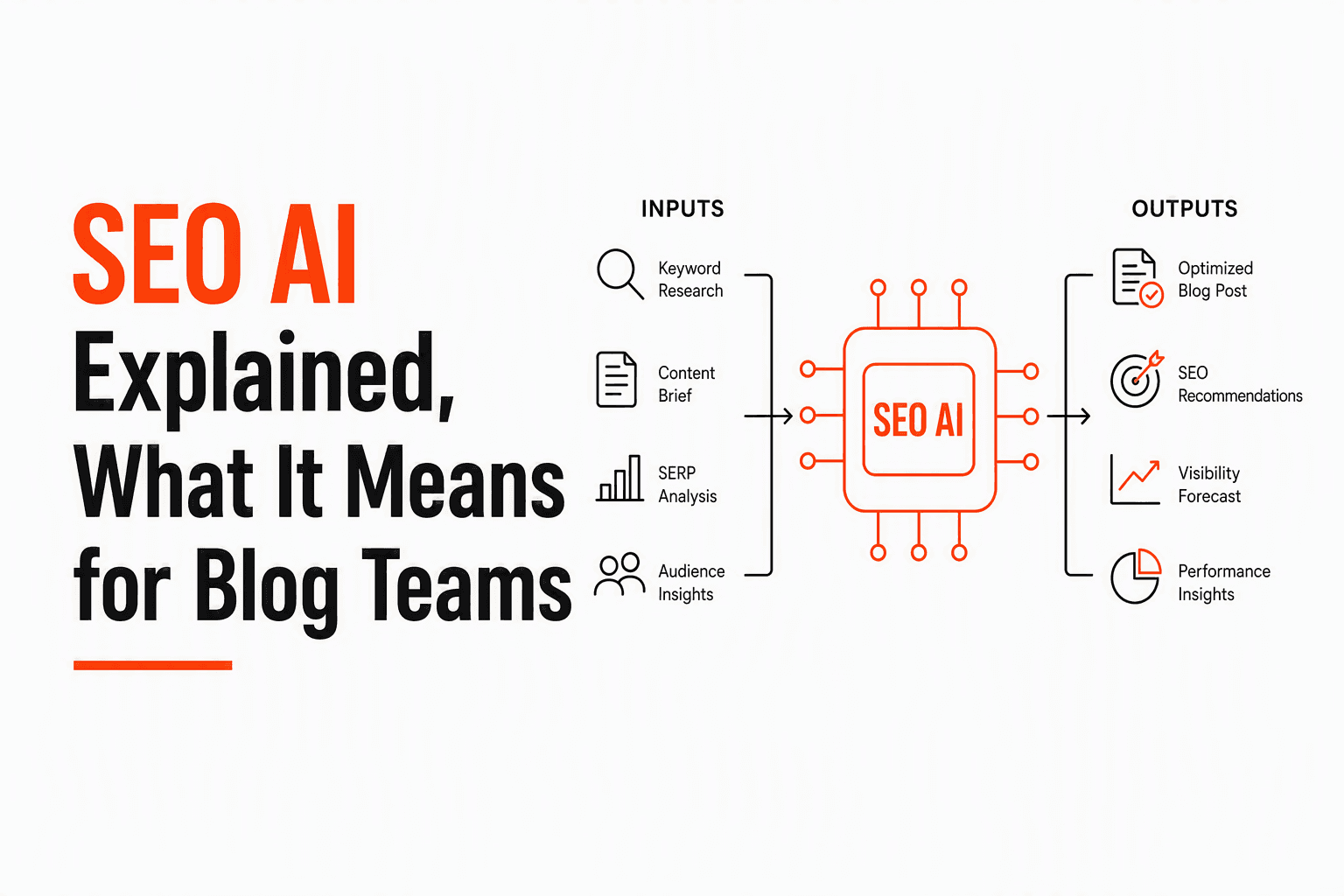
SEO AI is the use of AI systems to support search-focused decisions and production steps, like picking topics, shaping outlines, drafting sections, and improving on-page signals, based on SEO inputs rather than generic prompts alone. Teams use seo ai to move faster without guessing, but it still needs human judgment for strategy, accuracy, and brand quality.
- SEO AI is not just “AI writing”; it is AI guided by search intent, keywords, SERP patterns, and on-page requirements.
- The safest way to use seo ai is as a workflow assistant across research, outline, draft, and optimize, with clear checkpoints.
- Evaluate tools by inputs, controls, and quality checks, not by how “human” the first draft sounds.
What SEO AI Means and Why People Use the Term
SEO AI describes AI applied to ranking-driven content work, where the AI is constrained by search intent, target queries, SERP structure, and on-page SEO rules rather than freeform creative writing. That distinction matters because a generic text generator can produce a fluent article that still misses the query, wastes headings, or targets the wrong angle for the results page you actually need to compete with.
The plain-English definition (and the “not that”)
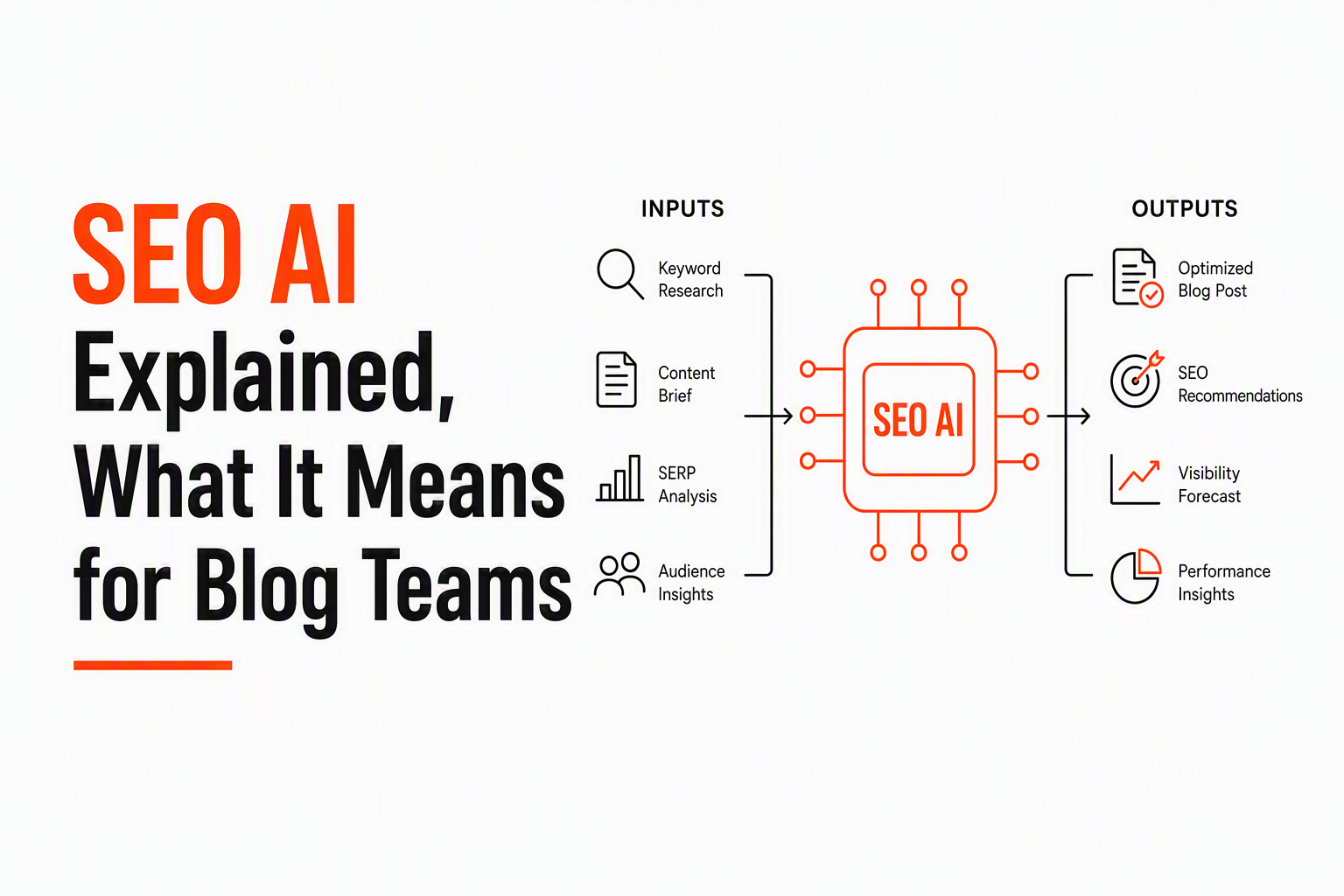
A practical definition you can use: seo ai is AI that takes SEO inputs (keyword, intent, audience, competitors, internal links, page goals) and turns them into SEO outputs (a structured outline, section-by-section coverage, titles/meta, internal link suggestions, and optimization ideas). By contrast, “AI writing” often means: you paste a prompt, you get text, and you manually retrofit it to what search needs.
A quick expectation reset for beginners
SEO AI does not “guarantee rankings” because rankings depend on competition, links, site quality, and how well your page satisfies intent. What it can do reliably is reduce the manual labor of producing a page that is at least structurally eligible to rank: clear hierarchy, intent match, coverage, and basic on-page signals.
How to tell if something is actually SEO AI
- It starts with SERP reality: the workflow references intent and what already ranks, not just a topic.
- It produces SEO artifacts: headings that map to subtopics, suggested internal links, and optimization notes, not only paragraphs.
- It has constraints: style rules, do and do-not lists, and optional outlines that keep output consistent.
How SEO AI Fits Into a Blog Workflow
SEO AI fits best as a set of repeatable checkpoints inside a blog workflow, because each checkpoint has clear inputs and a clear definition of “done.” If you treat it like a one-shot writer, you tend to get unpredictable results; if you treat it like a process assistant, you get consistent drafts your team can ship faster.
A 4-stage starter framework (inputs and outputs)
- Research and targeting
Inputs: primary keyword, related queries, audience pains, conversion goal, and what you already cover.
Outputs: intent statement, angle, must-answer questions, and a short “topic boundary” (what to exclude). - Outline and coverage
Inputs: intent statement, competitors’ common sections, your unique POV, internal pages to link.
Outputs: H2/H3 outline, section goals, and “proof needed” notes (what requires citations vs. experience). - Drafting
Inputs: outline, style rules, examples, product or brand constraints, terminology list.
Outputs: section drafts that follow hierarchy, plus suggested titles and meta description. - Optimization and QA
Inputs: draft, on-page checklist, internal link targets, image requirements, factual claims to verify.
Outputs: revised draft, link placements, and a punch list of fixes before publish.
Where teams usually waste time (and where AI helps most)
In our experience working with agency content teams, the biggest time sink is not typing sentences, it is the back-and-forth on scope: what to include, what to cut, and how to align the piece with the SERP. SEO AI helps most when it is used to lock scope early (research and outline), so drafting becomes execution rather than debate.
A minimal “definition of done” for each stage
- Research is done when you can write a one-sentence intent statement and list 5 to 8 sub-questions the post must answer.
- Outline is done when every H2 has a purpose, and every H3 prevents a common reader question from being missed.
- Draft is done when each section opens with the answer, then supports it with an example, criteria, or step-by-step guidance.
- QA is done when factual claims are checked, internal links make sense, and the post reads like one voice.
Related workflows you can reference next
If you want a deeper, end-to-end view of how AI supports search tasks beyond writing, see ai for seo. If you prefer a more technical breakdown of repeatable steps, artificial intelligence seo is a useful companion read.
The Biggest Benefits for SEO Content Teams
SEO AI creates value when it reduces cycle time and variance, meaning you publish more pages that meet the same quality bar with fewer bottlenecks. The benefits below are most noticeable for teams that publish frequently, manage multiple stakeholders, or need consistent structure across many posts.
Benefit 1: Speed without skipping the important steps
Done well, seo ai speeds up the parts that are easiest to standardize: first-pass outlines, draft scaffolding, and on-page checklists. The key is that “speed” comes from fewer blank-page moments and fewer reworks, not from pushing unreviewed content live.
What surprised our team was how often a fast outline prevented hours of rewrite later: if the outline matches intent and includes the right subtopics, the first draft is usually 80 percent of the way there.
Benefit 2: Consistency across writers and clients
Consistency is an SEO advantage because it makes outcomes more predictable. With clear rules and templates, seo ai can help keep headings, tone, and coverage patterns stable even when different people touch the work. That matters when you have multiple writers, multiple reviewers, or multiple client brands.
A concrete way to operationalize this is to create a “content spec” that the AI must follow every time:
- Audience and pain point in 1 sentence
- Primary query and 3 to 6 secondary queries
- Mandatory H2 sections (or required talking points)
- Banned claims (anything you cannot verify)
- Voice rules (formal vs. casual, first vs. second person)
Benefit 3: Scale that does not require linear headcount
Scaling a blog usually increases coordination costs: more briefs, more editing, more formatting, and more publishing steps. SEO AI can compress that coordination by generating a consistent first draft that editors can polish rather than rebuild. This is also where content operations start to overlap with what is seo automation, because repeatability becomes the real win.
Benefit 4: Faster iteration and learning
Search is an iterative channel. Faster drafts mean you can test more angles, refresh older posts sooner, and respond to changes in SERPs. A simple iteration loop looks like this:
- Publish a post with clear intent match.
- Watch queries and pages in Google Search Console (impressions and clicks by query).
- Update sections that underperform by adding missing sub-answers and improving internal linking.
Where SEO AI Still Needs Human Judgment
SEO AI still needs human judgment wherever the work depends on accountability, unique expertise, or business tradeoffs. If a mistake could damage trust, mislead readers, or misrepresent your brand, that step should be owned by a person and only assisted by AI.
Limitation 1: Accuracy and “confident wrong” outputs
AI text can sound plausible while being incorrect, especially on topics that change quickly or require niche domain knowledge. A practical rule we use is: any claim that includes a number, a date, a legal/medical recommendation, or a “best” assertion must be verified against a primary source before it ships.
For factual standards and what Google expects from pages that impact users, review the quality guidance in Google Search documentation and align your internal review accordingly.
Limitation 2: Brand voice and positioning are strategic, not generative
Voice is more than tone; it is what you choose to emphasize, what you omit, and how you frame tradeoffs. AI can follow rules, but it cannot decide your positioning. The fix is to provide voice constraints and examples, then have an editor ensure the article reflects your real perspective.
Limitation 3: Originality and “information gain”
Pages win when they add something useful beyond what is already ranking: a clearer framework, a better example, a sharper checklist, or firsthand lessons. SEO AI can summarize patterns, but it will often reproduce the average of what it has seen. To counter that, require at least one of the following in each post:
- A decision checklist (what to do and when)
- A worked example with assumptions stated
- A process you actually use internally
- A short comparison table of options or criteria
Limitation 4: Strategy and prioritization cannot be outsourced
Choosing which topics to publish, which pages to refresh, and which products to emphasize are business decisions. After running dozens of content audits, the pattern was clear: teams that let AI pick topics without constraints often drift into low-conversion, high-effort content that looks good but does not move pipeline.
How to Evaluate SEO AI Before You Try It
Evaluating SEO AI is easiest when you score the workflow on inputs, controls, and quality checks, because those determine whether output is repeatable. A beginner-friendly evaluation should answer one question: can this system consistently produce a draft that matches intent and meets our publishing standards?
A 10-point checklist you can use in a demo or trial
- Intent control: Can you specify the search intent and target reader in plain language?
- Outline control: Can you lock an outline, or require specific H2/H3 sections?
- Keyword guidance: Can you provide primary and secondary queries without stuffing?
- Source discipline: Can you force citations, or at least flag claims that need verification?
- Brand rules: Can you store tone, do-not-say terms, and formatting rules?
- Internal linking: Can you suggest links from a defined set of pages (not random URLs)?
- Image handling: Can it propose image ideas and placements aligned to the sections?
- Revision workflow: Can you regenerate only one section without rewriting the whole post?
- Quality checks: Does it run an on-page checklist (headings, meta, structure) before “done”?
- Publishing fit: Can the output land cleanly in your CMS without manual reformatting?
Two quick “trial tasks” that reveal quality fast
- Task A: Outline-only test. Give the system one keyword and ask for an outline plus section goals. If the outline does not match the SERP intent, the drafts will not either.
- Task B: Rewrite a single section. Provide a weak section from an existing post and ask it to improve clarity and completeness without changing the overall angle. Good seo ai workflows should improve the section without drifting off-topic.
How to avoid the most common evaluation trap
The most common trap is judging tools by the first draft alone. A better benchmark is: how many minutes does it take to get from keyword to a publishable version your editor approves? If you want ideas on tightening output so it reads less generic, write blogs with ai breaks down a practical approach.
| Workflow stage | What to ask of SEO AI | Human check before publish |
|---|---|---|
| Research | Intent statement, sub-questions, exclusions | Does this match what the SERP rewards? |
| Outline | H2/H3 hierarchy with section goals | Are we adding anything unique or clearer? |
| Draft | Section drafts that answer first, then explain | Are claims accurate and examples relevant? |
| On-page optimization | Meta draft, internal link suggestions, readability fixes | Do links and titles reflect our priorities? |
| Publishing | Clean formatting for CMS | Final proof for voice, compliance, and UX |
FAQ about SEO AI
Is seo ai the same as using ChatGPT to write a blog post?
No. A generic chatbot can generate text, but seo ai usually implies a workflow that is guided by search intent, keywords, SERP patterns, and on-page requirements, with controls and checks that make output repeatable.
Will seo ai content rank on Google?
seo ai content can rank if it satisfies intent, is accurate, provides real value, and your site has the authority and technical foundation to compete. AI does not remove the need for good strategy, editing, and quality control.
What is the safest way to start using seo ai?
Start by using AI for research and outlines, then draft with strict rules and add a human QA pass for accuracy, voice, and originality. Treat the first month as an experiment with clear acceptance criteria.
What should humans always do in an seo ai workflow?
Humans should own topic prioritization, fact-checking, positioning, and the final editorial decision. Anything that affects trust, compliance, or brand reputation should not be fully automated.
If you want a repeatable way to apply seo ai without rebuilding the process from scratch, Better SERP offers workflow templates designed for SEO agencies to move from keyword to publish-ready articles with consistent rules and quality checks. Treat it as a next step once you have your checklist and approval standards defined.
Read Next
View all
How To Rank Your Blog, A Beginner Workflow Using Free Tools
Learn how to rank your blog with a beginner workflow: indexing, intent, on-page SEO, troubleshooting, and a 30-day plan using free tools.
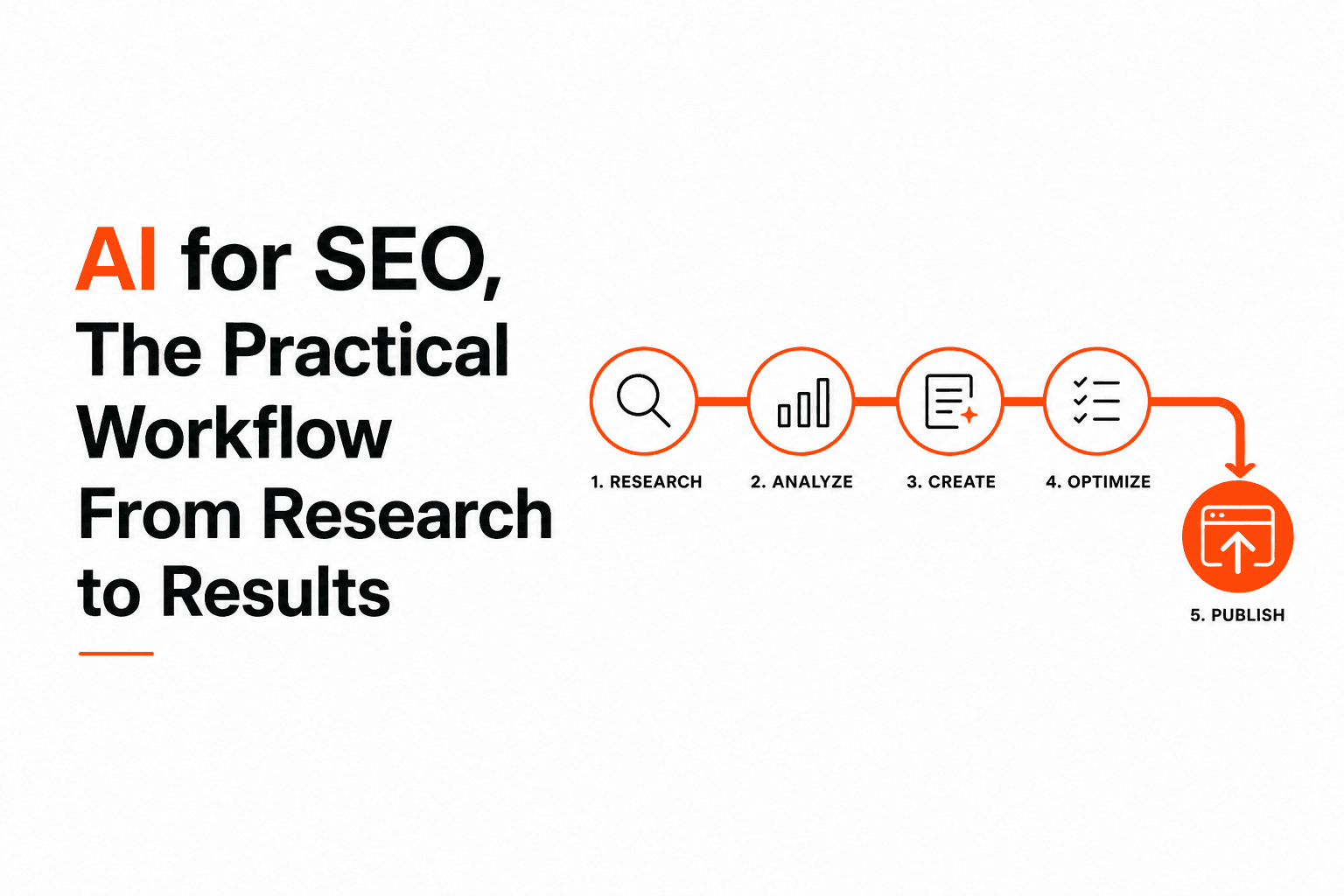
AI for SEO, The Practical Workflow From Research to Results
A practical ai for seo workflow from keyword research to publishing and measurement, with templates, QA checks, and governance to avoid generic content.
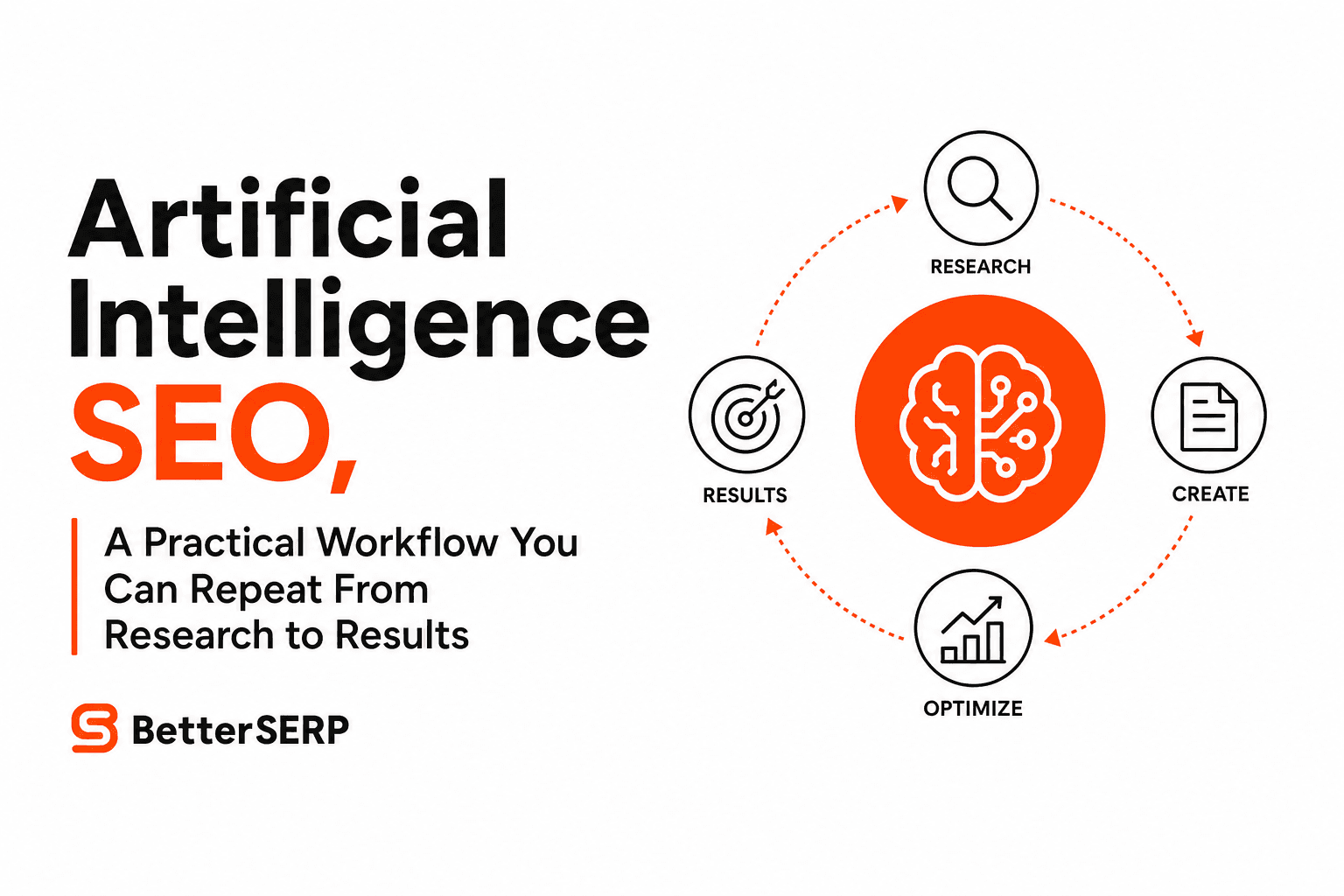
Artificial Intelligence SEO, A Practical Workflow You Can Repeat From Research to Results
Artificial intelligence seo in 2026, a tool-agnostic workflow for research, drafting, QA, AI Overviews optimization, and measurement.