
Artificial Intelligence SEO, A Practical Workflow You Can Repeat From Research to Results
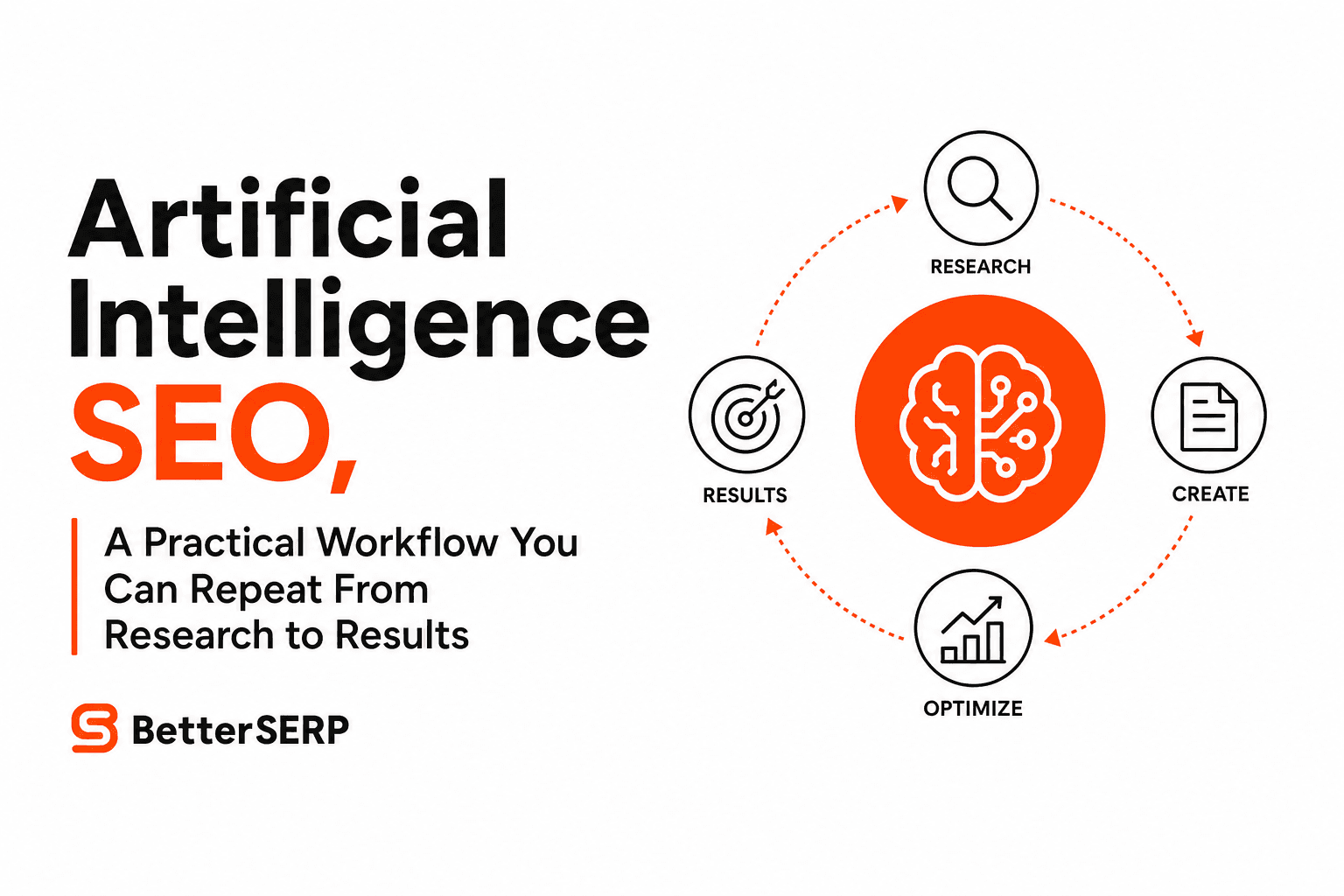
Artificial intelligence seo is the practice of using AI to speed up and standardize SEO research, content production, on-page improvements, and performance analysis, while still relying on human judgment for strategy and accuracy. The goal is not to “let AI rank your site,” but to connect real search data, repeatable prompts, and a QA gate so your outputs are publishable and measurable in an AI Overviews era.
- Anchor AI outputs to real inputs (GSC queries, SERP patterns, sourceable facts) so content stays accurate and citable.
- Use a repeatable workflow with defined inputs and outputs, plus a human QA gate before publishing.
- Measure success beyond rankings by tracking AI-era visibility signals and on-page engagement together.
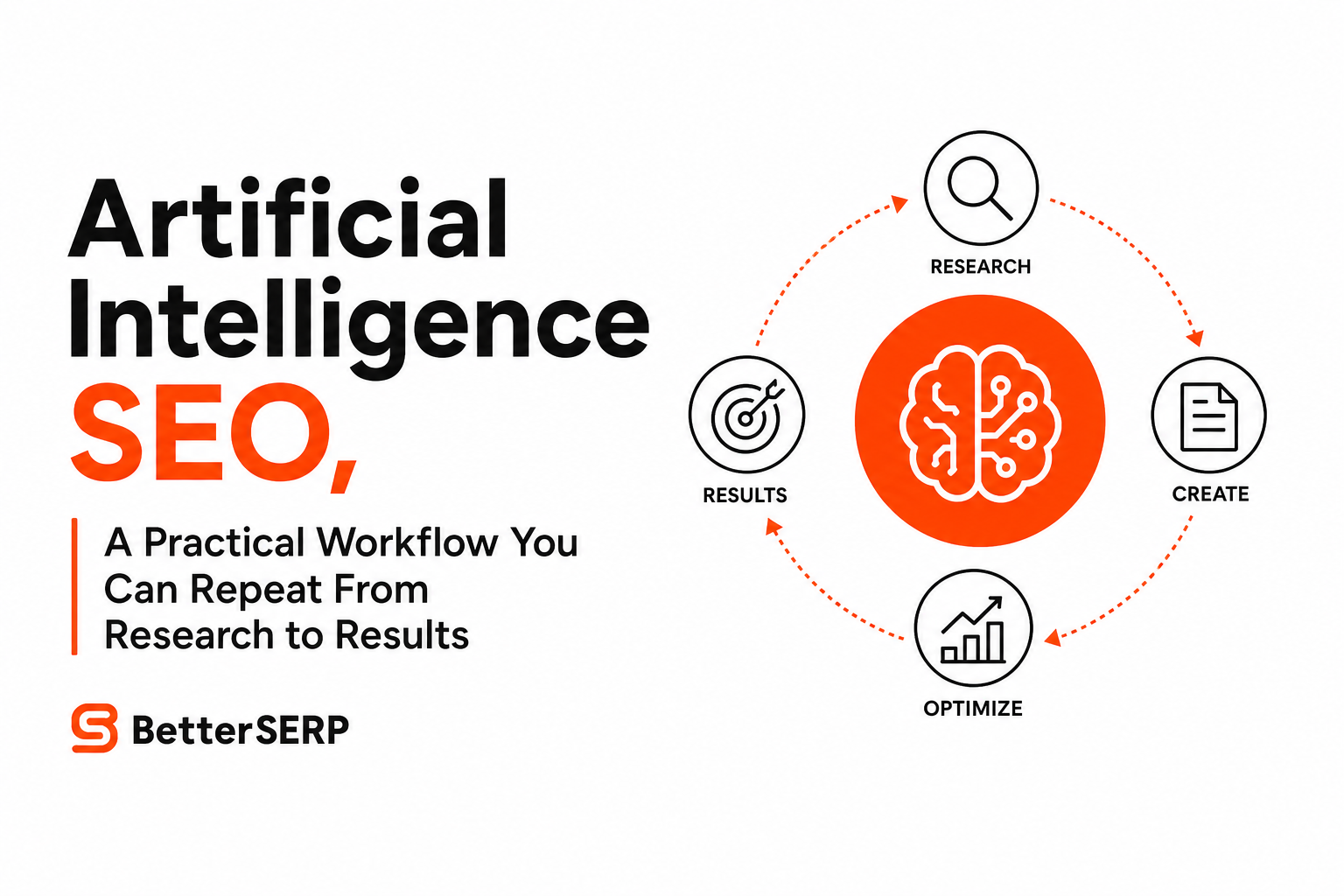
What Artificial Intelligence SEO Means in 2026 and What It Does Not
Artificial intelligence SEO in 2026 works best as an “assistant layer” that turns messy SEO inputs into consistent drafts, checklists, and decisions, not as an autonomous ranking system. If you treat AI as a workflow component, you can reliably reduce time spent on summarizing SERPs, outlining, and first drafts, while keeping humans accountable for correctness, positioning, and brand risk.
What AI can do well for SEO (repeatably)
- Pattern extraction: summarize intent patterns, common subtopics, and format expectations from a set of SERP pages you provide.
- Draft structured deliverables: content briefs, outlines, FAQs, meta descriptions, internal link suggestions, and refresh notes.
- Quality assistance: flag missing sections, unclear definitions, and places where claims need sources.
What AI does not do (where teams get burned)
- It does not “know” your niche facts: it predicts text. Without sources, it can invent details.
- It does not replace query strategy: you still choose which searches matter and which pages deserve investment.
- It does not guarantee compliance: legal, medical, and financial content still needs review and approvals.
A 3-question gate before you use AI on an SEO task
- Is the input verifiable? (GSC queries, a list of URLs, product docs, citations) If not, fix inputs first.
- Is the output reviewable? (outline, brief, draft, checklist) If you cannot review it quickly, you cannot trust it.
- Is there a clear success metric? (CTR, impressions, conversions, AI citations) If not, you will not know if it worked.
SEO vs AEO vs GEO, A Simple Terminology Map and When Each Applies
SEO, AEO, and GEO are the same core discipline applied to different answer surfaces, so the fastest way to choose the right approach is to map the query to where the answer will be consumed. In practice, you still start with intent and competition, then format the page so it can win a blue link, a snippet, or a generative citation.
Definitions in plain language
- SEO (Search Engine Optimization): earning organic traffic from classic search results and SERP features (links, snippets, “People also ask”).
- AEO (Answer Engine Optimization): structuring content to be selected as a direct answer (featured snippets, voice answers, concise definitions).
- GEO (Generative Engine Optimization): making content easy for generative systems (AI Overviews, ChatGPT-style tools) to cite accurately, with clear sourcing and extractable passages.
A decision tree you can use per query
- Is the query asking for a single best answer? (definition, steps, checklist) Prioritize AEO and GEO formatting: short answer first, then detail.
- Is the query comparative or exploratory? (best tools, alternatives, “vs”) Prioritize SEO depth plus a scannable comparison table.
- Is the query transactional? (pricing, near me, buy) Prioritize SEO fundamentals: landing page clarity, trust, and conversion elements.
What changes on the page (not just in your tool)
- For SEO: satisfy intent fully, build topical coverage, and earn links over time.
- For AEO: add “answer blocks” that can be lifted: 1 to 3 sentence definitions, numbered steps, and tight FAQs.
- For GEO: add citable statements with sources, consistent terminology, and explicit “who/what/when” context so passages stand alone.
The End-to-End Artificial Intelligence SEO Workflow, Inputs to Outputs
A reliable artificial intelligence seo workflow is a chain of inputs (data and sources) to outputs (brief, outline, draft, on-page, publish, measure) with a human QA gate before anything goes live. The point is to reduce variance: every keyword produces the same set of deliverables, and every deliverable has acceptance criteria.
Workflow map (inputs to outputs)
- Pick a target query set (from GSC and keyword tools) and define intent.
- Collect SERP evidence (top pages, headings, formats, gaps).
- Build a content brief (angle, audience, entities, must-cover sections, sources to cite).
- Generate an outline and draft with prompts constrained by the brief.
- Run human QA (accuracy, sourcing, brand voice, compliance, internal links).
- Publish and index (CMS, sitemap, internal link placement).
- Measure and refresh (GSC, GA4, Bing, and AI visibility checks).
Step 1: Choose queries using free, first-party data
Start with Google Search Console queries because they are already tied to your site and real impressions. Export queries for a page or a topic folder, then classify them by intent (definition, how-to, comparison, troubleshooting) and by page type (blog, glossary, product, category).
- Input: GSC export (query, clicks, impressions, CTR, position).
- Output: a short list of “primary query + 5 to 10 supporting queries” per page.
- Acceptance criteria: each supporting query is meaningfully different (not just plural/singular) and maps to a section you can write.
Step 2: Build a SERP evidence pack (10 minutes, no paid tools required)
Collect the top ranking pages and note what Google is rewarding: content format, depth, and recurring subtopics. Save 5 to 8 competitor URLs, plus any official standards or documentation you can cite.
- Input: top SERP URLs, “People also ask” questions, and snippet patterns.
- Output: an evidence pack: URL list + bullets on patterns and gaps.
- Acceptance criteria: you can point to at least 3 patterns (for example: “most results include a checklist,” “most define terms early,” “most include schema or FAQs”).
Step 3: Copy-paste prompt for a content brief (tool-agnostic)
Use AI to draft the brief, but constrain it to your inputs so it cannot invent strategy. Paste your query set, your audience, and your evidence pack, then ask for a brief with explicit deliverables.
Prompt template (brief):
You are an SEO strategist. Create a content brief for the primary query: [PRIMARY QUERY].
Supporting queries: [LIST 5-10].
Audience: [WHO].
Goal: [INFORMATIONAL / COMPARISON / TRANSACTIONAL].
SERP evidence (URLs + notes): [PASTE].
Constraints:
- Do not invent statistics or facts. Mark any claim that needs a citation as [CITE].
- Provide: recommended angle, H2/H3 outline, must-cover entities/terms, suggested internal link targets (generic), and a list of 5-8 source types to cite.
- Include a “citable answer block” (2-3 sentences) for the primary query.
Output in a structured list.
Step 4: Draft the article with a QA-ready structure
Generate the draft from the brief and require the model to produce sections that can be reviewed independently: definitions, steps, and checklists. When we tested “brief-first drafting” versus “prompt-only drafting,” our team found review time dropped because fewer paragraphs wandered away from the target query and fewer claims lacked a place to attach a source.
Prompt template (draft):
Write a long-form article based ONLY on this brief: [PASTE BRIEF].
Rules:
- Start each H2 with a self-contained answer sentence.
- Use checklists and numbered steps where helpful.
- If a statement requires a source and none is provided, label it [CITE] instead of guessing.
- Keep tone beginner-friendly and practical.
Output HTML headings (H2/H3) and paragraphs.
Step 5: Human QA gate (non-negotiable)
Use a fixed checklist so every piece gets the same scrutiny. This is the part that keeps artificial intelligence seo from turning into “publish first, apologize later.”
- Accuracy: remove or source any [CITE] items; verify definitions; check examples match the industry.
- Intent match: confirm the primary query is answered directly in the first 100 words of the page.
- Extractability: ensure at least 3 passages can stand alone (definition, steps, criteria list).
- Internal linking: add 2 to 5 relevant internal links where they genuinely help the reader.
- On-page basics: unique title tag, meta description, heading hierarchy, image alt text, and schema only if accurate.
A Free AI SEO Starter Stack You Can Use Today
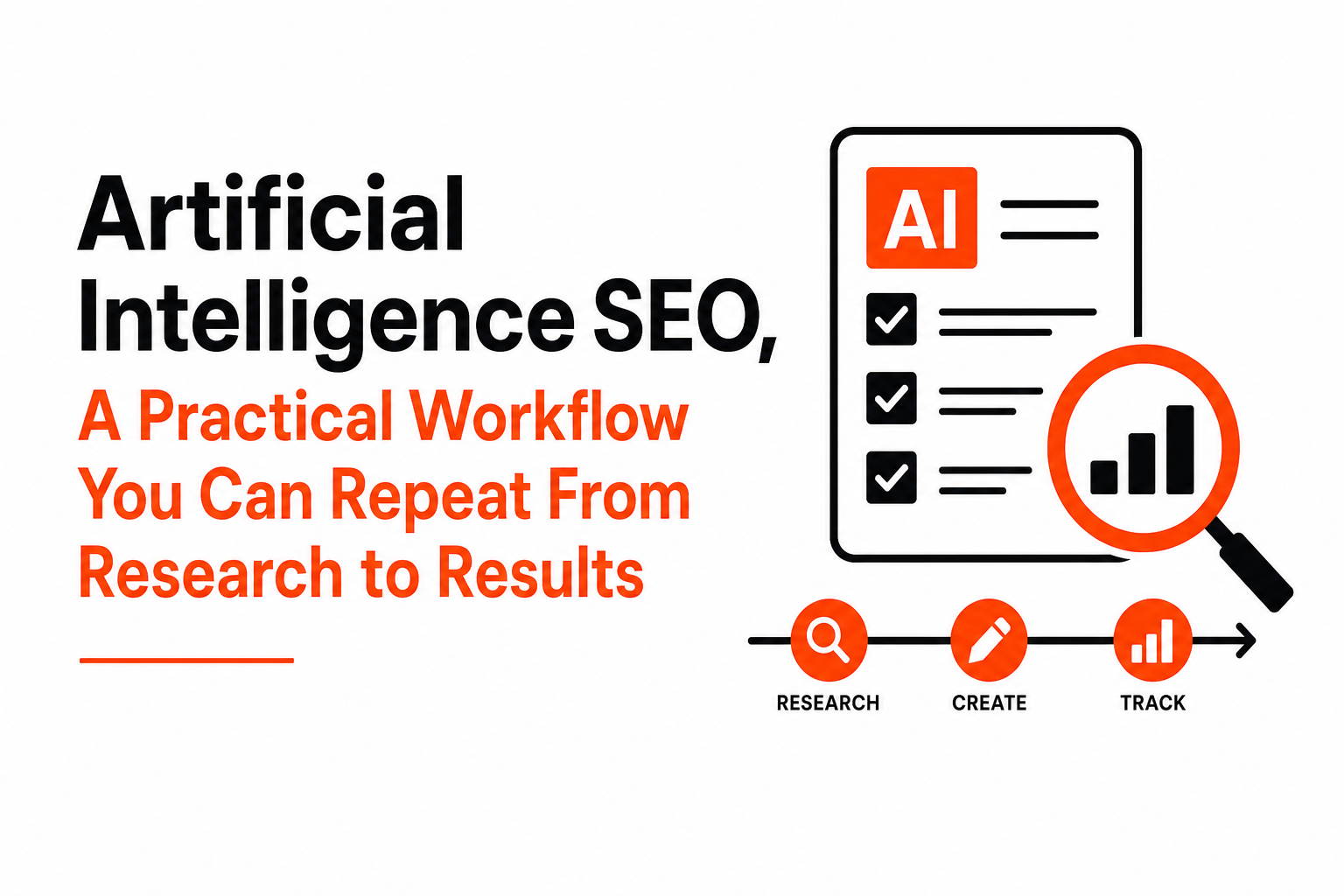
A free starter stack for artificial intelligence seo is enough to run the workflow end-to-end if you use first-party data for targeting and keep AI constrained to summarization and drafting. The main limitation of free tools is not “quality,” it is throughput: exporting, cleaning, and tracking at scale becomes manual.
Starter stack (free or widely available)
- Google Search Console: query discovery, page-level performance, and refresh opportunities.
- Google Trends: seasonality checks and topic timing (useful for editorial planning).
- Google Sheets: workflow tracker: keyword, URL, status, publish date, last updated, notes.
- Your browser + a note doc: SERP evidence pack (URLs, patterns, PAA questions).
- An AI chat tool: brief and draft generation using the prompt templates above.
How to chain the stack (a practical sequence)
- Export GSC queries for a topic folder or page group.
- Cluster queries manually in Sheets (start simple: one cluster per page).
- Collect 5 to 8 SERP URLs and paste notes into the sheet.
- Run the “brief” prompt, paste the output back into the sheet.
- Run the “draft” prompt, then QA and publish.
When paid upgrades become necessary (clear triggers)
- You manage many sites: multi-client reporting and repeatable templates matter more than one-off chats.
- You publish frequently: scheduling, consistent formatting, and CMS connections prevent bottlenecks.
- You need governance: standardized QA checklists and brand rules reduce risk across writers and accounts.
How to Optimize for AI Overviews, ChatGPT, and Perplexity Without Guessing
Optimization for AI Overviews and other generative tools is mostly about making your page easy to cite accurately, with clear answers, consistent terminology, and sourceable statements. Instead of chasing hidden “AI ranking factors,” focus on extractable passages and visible evidence.
Write “citable passages” (a simple format)
- Lead with the answer: 1 to 3 sentences that define the term or give the steps.
- Add constraints and context: who it applies to, what it excludes, and when it changes.
- Support with a short list: criteria, steps, or checks that are easy to quote.
On-page structure that tends to be cited
- Clear heading hierarchy: one topic per H2, one subtopic per H3.
- Lists that match intent: numbered steps for how-to; bullet criteria for “choose X.”
- FAQ section: only if questions are real and answers are tight and accurate.
Schema: use it only when it is true
Schema does not replace good content, but it can reduce ambiguity about what the page contains. Use FAQPage for genuine FAQs, HowTo for real step-by-step instructions, and Article/BlogPosting for basic publishing metadata. Reference: Schema.org.
Platform-specific notes (practical, not magical)
- Google AI Overviews: prioritize direct relevance and passages that can stand alone; avoid burying the definition under long introductions.
- Perplexity-style tools: citations are prominent, so include links to primary sources where possible and keep claims tightly scoped.
- ChatGPT-style answers: clarity and consistent terminology help; include “what it is / when to use / pitfalls” sections to reduce misinterpretation.
We initially assumed longer pages would always be cited more, but our team found short, well-labeled answer blocks inside a comprehensive page were easier to reuse accurately because the key statements were not diluted by unrelated narrative.
How to Measure AI-Era SEO, KPIs and a Simple Tracking Setup
Measurement for artificial intelligence seo should combine classic organic KPIs with a lightweight way to monitor AI-era visibility, because rankings alone do not explain whether your content is being used as an answer. The practical approach is a weekly cadence for page health and a monthly cadence for content decisions.
Core KPIs (classic SEO, still required)
- GSC clicks and impressions per page and per query cluster.
- CTR for top queries (watch for drops when SERP layouts change).
- Average position as a directional signal (not a single source of truth).
- Engagement and conversions in GA4: time on page is less reliable than scroll depth, events, and leads.
AI-era visibility signals (simple and honest)
- Snippet and feature presence: track whether you appear in featured snippets or “People also ask” for target queries.
- Branded query lift: monitor GSC for increases in brand or product-name searches after publishing helpful guides.
- Manual citation checks: for a small set of priority queries, check whether AI tools cite your page and whether the citation is accurate.
Tracking setup (30 to 60 minutes)
- Create a content tracker sheet with columns: URL, primary query, publish date, last updated, internal links added, notes.
- Connect GA4 events that matter (form submit, trial click, demo click, download) and map them to the content URLs.
- Set a GSC review rhythm: weekly check for anomalies; monthly export for refresh candidates.
- Add Bing Webmaster Tools for additional query data and indexing diagnostics: Bing Webmaster Tools.
A refresh trigger checklist (use this instead of guessing)
- CTR drops while impressions hold steady.
- Impressions drop after a SERP change or competitor updates.
- New supporting queries appear in GSC that your page does not answer yet.
- AI citation is wrong or missing key context, suggesting your page needs clearer “answer blocks.”
Governance and Risk Controls for AI-Assisted SEO Content
Governance is the difference between scalable artificial intelligence seo and scalable mistakes, so every team needs a written set of rules for sourcing, brand voice, and approvals. You do not need a complex policy to start, but you do need a consistent checklist that is enforced.
Risk control checklist before publishing
- Hallucination control: every non-obvious claim is either cited, removed, or rewritten as a conditional statement.
- Source quality: prefer primary sources (standards bodies, official docs, original research) over rephrased summaries.
- Brand voice: apply a short style guide (tone, forbidden claims, formatting rules, reading level).
- Compliance: add required disclaimers, avoid prohibited advice, and route to approval when needed.
- Plagiarism check: ensure the draft is original and not a paraphrase of a single source page.
Practical governance roles (even for a small team)
- Strategist: owns query selection, intent, and success metrics.
- Editor: owns clarity, structure, and brand voice.
- Subject reviewer (as needed): validates correctness in sensitive niches.
How to document decisions so AI content stays consistent
Store three things per topic: the brief, the sources used, and the QA checklist result. After running a few cycles, the pattern becomes clear which prompts produce reviewable drafts and which create extra cleanup work.
| Workflow step | Best AI use | Human QA focus | Output artifact |
|---|---|---|---|
| Query selection | Cluster and summarize query themes | Choose priorities and intent | Keyword cluster list |
| SERP evidence | Extract patterns from provided URLs | Confirm gaps and differentiation | Evidence pack |
| Brief | Draft outline and must-cover sections | Lock angle, sources, constraints | Content brief |
| Draft | Write first version with structure | Fact-check, edit, add links | Publish-ready draft |
| Measurement | Summarize trends and anomalies | Decide refresh actions | Monthly insights notes |
FAQ
Is artificial intelligence seo just using AI to write blog posts?
No. Artificial intelligence seo is broader: it includes AI-assisted research, brief creation, outlining, drafting, on-page improvements, internal linking suggestions, and performance analysis, with human QA for accuracy and intent.
Will optimizing for AI Overviews hurt traditional SEO?
Optimizing for extractable answers usually helps traditional SEO because it improves clarity and intent match. The risk comes from over-summarizing and removing depth; keep the short answer, then provide the full explanation.
What is the minimum QA I should do on AI-assisted content?
At minimum: verify every non-obvious claim, ensure the primary query is answered directly near the top, check internal links and headings, and confirm any schema used is accurate for the page.
Which internal resources should I read next to improve my workflow?
If you want a deeper workflow view, see ai for seo and what is seo automation. For writing execution, review write seo friendly article and search engine optimized content.
If you want to implement this workflow faster across multiple clients without reinventing briefs, prompts, and QA checklists each time, Better SERP offers ready-made AI workflow templates designed for SEO agencies so your team can standardize research-to-publish execution and focus more time on strategy.