
AI And SEO, What’s The Difference And How To Use Both Without Losing Quality
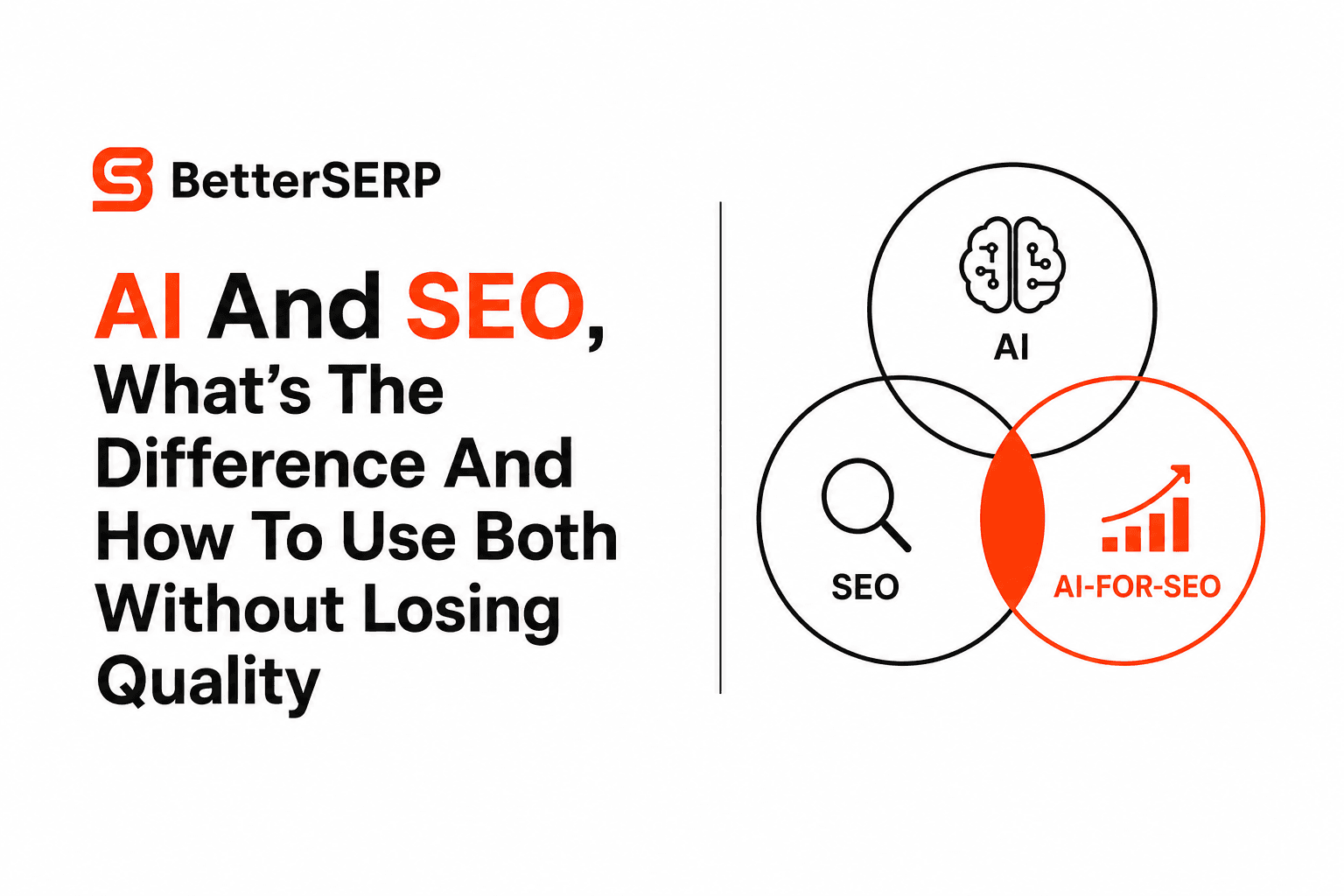
AI and SEO get lumped together, but they are not the same thing, and confusing them is how teams end up with content that looks “optimized” yet fails to rank or convert. This guide separates AI, SEO, and AI-for-SEO, then gives you a repeatable workflow (with prompts and QA) so you can use ai and seo together without losing quality.
- AI is a capability, SEO is a discipline, and AI-for-SEO is a workflow that uses AI to speed up specific SEO tasks without outsourcing judgment.
- The safest split is: AI drafts and analyzes, humans decide and validate (especially for intent, claims, and E-E-A-T signals).
- A repeatable SOP with a QA rubric beats “prompting harder” and is the fastest way to scale ai and seo work responsibly.
AI And SEO Explained, Plus The Key Differences
Three definitions that stop the confusion
AI (artificial intelligence) is a set of models that can generate, classify, summarize, and extract patterns from data. It is not a ranking system and it does not “do SEO” by itself.
SEO (search engine optimization) is the practice of improving a site’s visibility in search results by aligning content, technical foundations, and authority signals with what searchers want and what search engines can trust.
AI-for-SEO is the practical overlap: using AI to accelerate parts of SEO work such as outlining, drafting, entity coverage checks, internal linking suggestions, and content refresh analysis, while keeping humans accountable for strategy, accuracy, and brand risk.
A simple overlap model
- AI-only tasks: text transformation, clustering, summarization, extracting entities, generating variants.
- SEO-only tasks: deciding which topics matter commercially, prioritizing fixes, building authority, understanding SERP intent nuance.
- Overlap (AI-for-SEO): drafting content that follows a brief, mapping keywords to pages, creating structured outlines, producing meta tags, identifying gaps versus top results.
Comparison table: AI vs SEO vs AI-for-SEO
| Dimension | AI | SEO | AI-for-SEO |
|---|---|---|---|
| Primary goal | Generate or analyze information | Earn qualified organic traffic | Speed up SEO production and analysis |
| Success metric | Usefulness, coherence, accuracy | Rankings, clicks, conversions, revenue | Time saved without quality loss |
| Failure mode | Hallucinations, blandness, bias | Wrong intent, thin content, weak authority | Scaled mistakes faster |
| What humans must own | Prompting, validation, governance | Strategy, prioritization, accountability | Final decisions and QA gates |
Once you separate these, “ai and seo” becomes less about replacing a specialist and more about designing a workflow where AI does repeatable labor and people do the irreversible decisions.
Where AI Helps Most In SEO And Where Humans Must Lead
A decision tree you can actually use
Use this decision tree for any task in ai and seo:
- Is the output customer-facing or could it create legal or brand risk? If yes, human must approve and validate sources.
- Does the task require original experience, opinion, or accountability? If yes, human leads; AI supports with structure and drafts.
- Is it pattern-based and reversible? If yes, automate with AI and add spot checks.
- Can you objectively QA it with a rubric? If yes, it is a good candidate for AI assistance.
Task map: automate vs assist vs human-only
| SEO task | Best role for AI | Human responsibility (non-negotiable) | QA check |
|---|---|---|---|
| Keyword clustering | Automate | Confirm business priorities and page mapping | Spot check cluster intent and overlap |
| SERP intent summary | Assist | Validate by reviewing live SERP features | Match to content format (guide, list, tool, etc.) |
| Outline and headings | Assist | Ensure unique angle and completeness | Heading hierarchy and coverage vs competitors |
| First draft | Assist | Fact-check, add experience, remove fluff | Claims backed by sources or first-hand evidence |
| Internal linking suggestions | Automate | Confirm relevance and anchor naturalness | No forced anchors, no cannibalization |
| Technical SEO fixes | Assist | Decide priority and implement safely | Before/after crawl and performance checks |
| Content refresh plan | Automate + assist | Choose what to keep, cut, merge, or redirect | Traffic, rankings, and conversion deltas |
In our experience working with multi-client content teams, the biggest quality drop happens when AI is asked to “decide what matters” instead of being constrained to a brief and a QA rubric. Keep humans in control of intent, claims, and prioritization, and AI becomes a multiplier instead of a risk.
E-E-A-T guardrails for AI-assisted content
- Experience: add first-hand steps, screenshots you took, numbers from your own audits, or clearly labeled observations.
- Expertise: include decision criteria, not just tips (for example, “choose this structure when SERP has X”).
- Authoritativeness: cite primary sources for definitions and standards (Google docs, W3C, etc.).
- Trust: avoid unsupported medical, legal, or financial claims; keep a source list for any factual statement.
A Step-By-Step AI SEO Workflow You Can Repeat End To End
The 7-step SOP (keyword to refresh)
- Pick one search intent: informational, commercial, navigational, or transactional. Do not mix.
- Build a one-page content brief: primary keyword, secondary terms, audience, constraints, and “what must be true.”
- Outline from the SERP: extract common subtopics, then add a unique angle or missing section.
- Draft with AI inside constraints: require structure, examples, and “unknowns” flagged.
- QA with a rubric: factual accuracy, intent match, originality, internal links, and on-page basics.
- Publish with metadata: title tag, meta description, schema where relevant, and image alt text.
- Refresh loop: re-check after 30 to 60 days for query drift and content gaps.
Copy-paste prompts (beginner-friendly)
Prompt 1: SERP intent and content format
“You are an SEO analyst. For the keyword: [KEYWORD], infer the most likely search intent and the best content format to satisfy it. Output: (1) intent, (2) recommended page type, (3) must-cover subtopics, (4) what NOT to include, (5) 5 questions the reader wants answered.”
Prompt 2: Outline with heading hierarchy
“Create an outline for a post targeting [KEYWORD]. Constraints: use H2 and H3, avoid filler, include a checklist and a table, and add one section that is a unique angle not found in generic articles. Provide 1 sentence per heading describing what it covers.”
Prompt 3: Draft with evidence rules
“Write the section [PASTE HEADING]. Rules: (1) no unverified claims, (2) if you state a fact, add a source suggestion, (3) include one concrete example, (4) keep paragraphs under 4 lines, (5) end with a mini checklist.”
QA rubric (score out of 20)
- Intent match (0 to 4): does it answer the query without detours?
- Accuracy and sourcing (0 to 4): any claims that cannot be verified?
- Completeness (0 to 4): covers the “must-have” subtopics from the SERP?
- Original value (0 to 4): includes a framework, decision criteria, or experience-based steps?
- On-page SEO basics (0 to 4): headings, keyword placement, internal links, meta tags.
When we tested a strict QA gate like this (publish only at 16/20 or higher), we spent less time rewriting later because issues were caught before indexing. That is the core operational win of ai and seo: fewer cycles, not just faster drafts.
If you want a deeper beginner workflow for drafting, see write seo friendly article.
A Neutral AI SEO Tool Stack By Budget, Including Free Options
Choose tools by task, not by hype
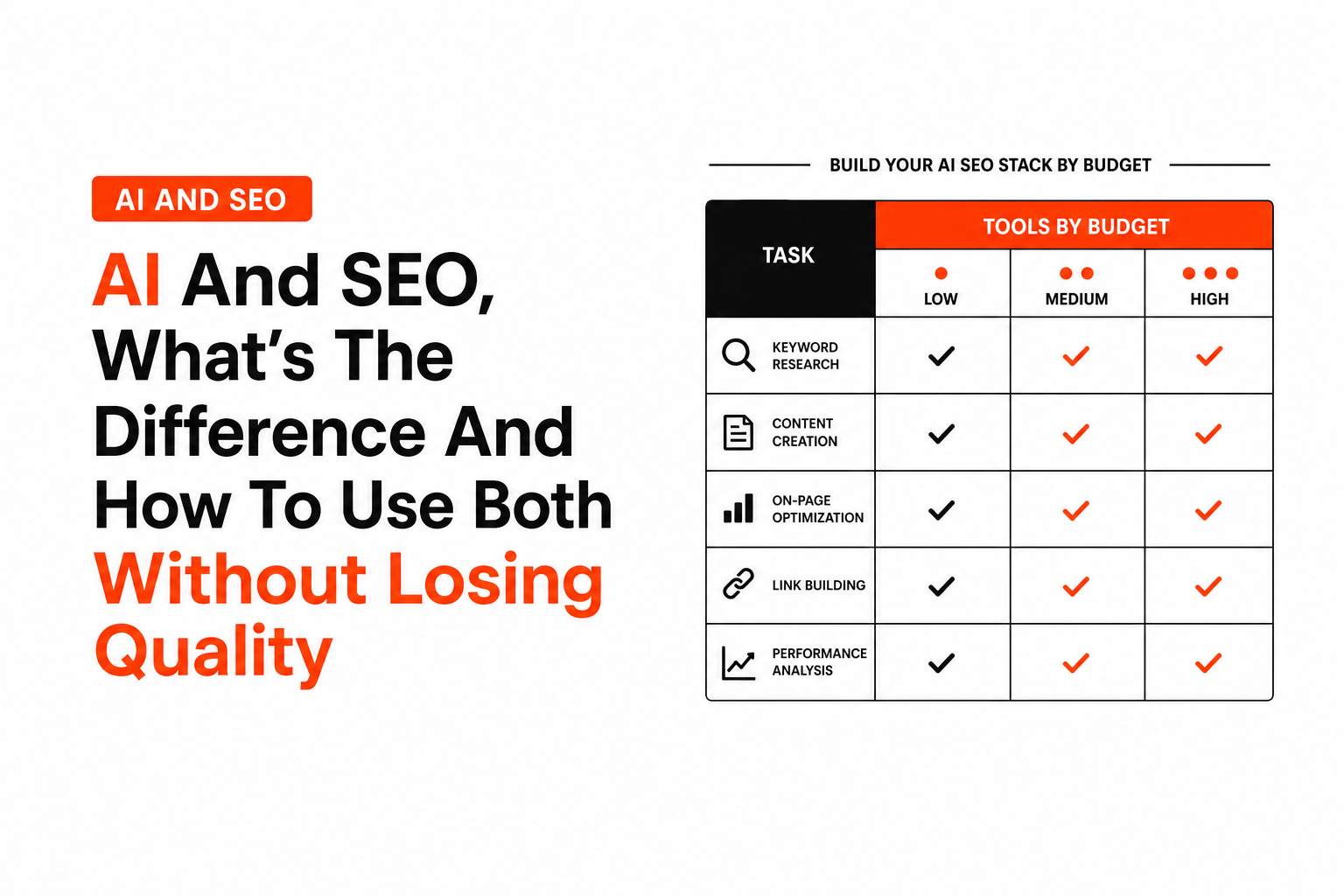
A useful way to evaluate ai and seo tooling is to start with tasks (research, drafting, QA, publishing, measurement) and only then pick tools. Below is a neutral matrix with “minimum viable” options and a more robust stack.
| Task | Minimum viable (free or low-cost) | Pro stack (paid) | What to verify |
|---|---|---|---|
| Keyword research | Google Search Console, Google Trends | Ahrefs or Semrush | Intent, difficulty, and cannibalization risk |
| Content briefing | Google Docs template | Briefing tool + SOP library | Clear constraints and “must be true” statements |
| Drafting | ChatGPT or Claude | Model + structured templates | Factuality and tone consistency |
| On-page QA | Manual checklist | Content scoring + crawl checks | Headings, entities, internal links, metadata |
| Technical checks | Lighthouse | Screaming Frog + log analysis | Indexability, speed, structured data |
| Publishing | Manual in CMS | API or CMS automation | Formatting, images, canonical, schema |
Budget rule of thumb
- Start free if you publish less than 4 posts per month and can QA manually.
- Go pro when QA time becomes the bottleneck, not drafting time.
- Automate publishing only after your brief and QA rubric are stable.
If you are new to the concept of automating repeatable SEO tasks, this guide on what is seo automation is a good foundation.
SEO For AI Search, How To Earn Citations In AI Overviews And Answer Engines
What “citation-worthy” content looks like
AI Overviews and answer engines tend to cite pages that are easy to extract from: clear definitions, structured steps, unambiguous comparisons, and specific supporting evidence. This is not separate from SEO, it is a stricter version of it, and it pushes teams to make ai and seo outputs more structured.
Checklist for earning citations
- Lead with a direct answer: 1 to 2 sentences that resolve the query.
- Use consistent structure: H2 for major concepts, H3 for steps, bullets for criteria.
- Add “extractable” assets: tables, checklists, formulas, decision trees.
- Define terms before arguing: avoid jargon and ambiguous pronouns.
- Support claims: cite primary sources where possible (standards, official docs).
- Entity clarity: use the same term for the same concept throughout the page.
Example outline structure that tends to get cited
- Definition (2 sentences)
- When to use it (bullets)
- Step-by-step process (numbered)
- Common mistakes (bullets)
- Tool matrix (table)
- FAQ (3 to 5 questions)
For a practical view of how structure and intent alignment affects results, this guide on search engine optimized content pairs well with the checklist above.
Google Search Central’s guidance on helpful content is also worth reviewing because it mirrors what answer engines reward: clarity, evidence, and satisfying the query.
The Next 90 Days, What To Change In Your SEO Process And What To Measure
A 90-day plan built around measurable outputs
Instead of “use more AI,” treat ai and seo as a process change with KPIs. Here is a simple 90-day plan you can run with a small team.
Days 1 to 30: lock the brief and QA system
- Create a one-page brief template (intent, audience, constraints, internal links, sources).
- Adopt the 20-point QA rubric and set a publish threshold.
- Define a “no-go” list: topics that require licensed expertise or legal review.
Days 31 to 60: scale production safely
- Batch outlines first, then drafts, then QA (reduces context switching).
- Standardize internal linking rules: 2 to 5 contextual links, no forced anchors.
- Track time per stage: brief, draft, edit, publish.
Days 61 to 90: build the refresh loop
- Pick 10 pages and run a refresh audit: query drift, gaps, cannibalization, CTR.
- Update titles and intros where CTR is low but rankings are stable.
- Add sections that answer new sub-questions showing up in Search Console queries.
What to measure (weekly and monthly)
| Metric | Why it matters | Target direction |
|---|---|---|
| Publish velocity (posts/week) | Shows operational throughput | Up, without QA score dropping |
| QA score average | Prevents scaling low-quality pages | Stable or up |
| Indexed pages and coverage errors | Ensures content can rank | Errors down |
| Non-branded clicks | Measures demand capture | Up |
| Top 3 and top 10 keywords | Tracks ranking improvements | Up |
| Refresh impact (before/after clicks) | Validates iteration loop | Up |
What surprised our team was how often “AI problems” were actually measurement problems: teams scaled drafts but did not track QA scores, refresh impact, or cannibalization, so they could not tell if ai and seo were improving outcomes or just increasing output.
| Common ai and seo mistake | What it looks like | Fix |
|---|---|---|
| Publishing without intent validation | High impressions, low clicks, high bounce | Rewrite intro and structure to match SERP format |
| No source discipline | Confident but wrong claims | Add a “must cite or remove” rule in QA |
| Over-optimizing keywords | Awkward repetition | Use entity coverage and natural phrasing |
| Ignoring internal links | Orphan pages, weak topical clusters | Maintain a link pool and add contextual links |
| No refresh loop | Rankings decay over time | Schedule 30 to 60 day refresh reviews |
FAQ
Is ai and seo the same as using AI to write blog posts?
No. AI writing is only one small part. AI-for-SEO includes briefing, intent mapping, gap analysis, internal linking suggestions, refresh planning, and QA. The key is that humans still own strategy and validation.
Will Google penalize AI content?
Google’s guidance focuses on content quality and usefulness, not whether a human or AI typed the first draft. The practical risk is publishing inaccurate, thin, or unhelpful pages at scale. A QA rubric and source discipline reduce that risk.
What is the safest way to start with ai and seo?
Start by using AI for reversible tasks: outlines, summaries, meta descriptions, and content refresh suggestions. Keep humans responsible for intent validation, factual accuracy, and final edits, then measure outcomes in Search Console.
How do I know if my AI-assisted content is actually improving SEO?
Track both production and performance: QA scores, publish velocity, index coverage, non-branded clicks, and before/after impact of refreshes. If output rises but non-branded clicks and top 10 rankings do not, your process likely needs better intent alignment or stronger differentiation.
If you want to operationalize this ai and seo workflow across multiple sites without adding more manual steps, Better SERP offers AI workflow templates that turn your brief and rules into consistent drafts, QA-ready structure, and scheduled publishing so your team can stay focused on strategy and review.

Selena
Turns content into a top performer across search engines and AI-powered answer platforms alike.