
Write SEO Friendly Article Steps Plus a Full Sample You Can Copy
Learn how to write seo friendly article content with a simple workflow, an annotated sample, and a checklist for title, meta, links, and FAQs.
Write seo friendly article content by matching search intent, using a clear heading structure, and delivering the answer fast with readable formatting, helpful links, and clean on-page basics.
- SEO friendly articles win by intent match plus scannable structure, not keyword stuffing.
- Draft first for clarity, then layer in internal links, media, and on-page deliverables (title, meta, URL, FAQ).
- Use the copyable sample and checklist to repeat the process in Google Docs or Notion.
What Makes an Article SEO Friendly in Plain English
An SEO friendly article answers the searcher’s question quickly, then proves it with clear structure and useful detail so both people and search engines can trust it.
SEO friendly means “easy to understand and easy to rank”
- Intent match: the page gives the same type of answer the query implies (definition, steps, comparison, template, etc.).
- Skimmable structure: descriptive H2s, short paragraphs, and lists so readers can find what they need in seconds.
- Topical completeness: covers the core subquestions without wandering into unrelated topics.
- On-page basics: a good title, meta description, sensible URL, internal links, and image alt text.
A quick do/don’t rewrite example
Don’t: “SEO writing is important because SEO helps websites rank and ranking is good for traffic.”
Do: “SEO writing means structuring an article around one search intent, using clear headings and natural keyword phrases so the page is easy to scan and easy to index.”
Intent check in 30 seconds
- Search your keyword and look at the top results’ format: are they guides, lists, templates, or product pages?
- Write a one-line promise: “This article will help you ____ by ____.”
- List 5 subtopics that appear across multiple top results (those are usually required sections).
Before You Write, Lock In Intent, Keywords, and a Skimmable Outline
A beginner-friendly way to write seo friendly article drafts is to decide the intent, pick one primary keyword plus a few supporting phrases, then outline H2s that mirror the reader’s next questions.
Step 1: Write an intent statement you can’t accidentally violate
Use this fill-in: “For [audience], this page provides [content type] so they can [primary outcome] without [common pain].”
- Audience: beginners writing their first SEO article
- Content type: step-by-step workflow + copyable sample
- Outcome: publish a structured post that matches intent
- Pain: guessing where keywords, links, and FAQs go
Step 2: Choose keywords using a simple “primary + support” rule
- Primary keyword: the exact query you want to rank for (here, “write seo friendly article”).
- Supporting keywords: 3 to 6 closely related phrases that help cover the topic (for example: “SEO friendly article sample”, “on-page SEO checklist”, “meta description for blog posts”).
In our experience working with newer writers, the biggest quality jump comes from limiting the draft to one primary keyword and using supporting phrases only where they clarify meaning, not as a quota to hit.
Step 3: Build an outline that maps to questions, not “SEO sections”
Use this outline pattern for most informational posts:
- Definition: what it is, in plain English
- Preparation: intent, keywords, outline
- Drafting: write clearly, then add links/media
- Example: a complete sample readers can model
- On-page deliverables: title/meta/URL/FAQ
- Optional: AI-assisted workflow + review checklist
Step 4: Create a “brief box” you can paste above the doc
- Target reader: beginners
- Primary keyword: write seo friendly article
- Search intent: how-to guide with sample
- Outcome: publish-ready structure + on-page elements
- Internal links to add: pick 2 to 4 that truly help (don’t force them)
Write the Draft Without Keyword Stuffing, Then Add Links and Media
A reliable way to write seo friendly article content is to draft for clarity first, then do one “SEO pass” to place the keyword naturally, add internal links, and insert images with descriptive alt text.
Drafting rules that prevent keyword stuffing
- Use the primary keyword in 3 to 6 places max in a typical blog post: intro, one H2, and a few natural mentions where it fits the sentence.
- Prefer partial matches and plain language once the topic is established (for example: “SEO friendly post”, “SEO writing workflow”).
- Keep paragraphs short: 1 to 3 sentences is a practical default for web readability.
Add internal and external links with a “reason to click” test
Only add a link if it helps the reader do the next step. For internal links, insert them at the first natural mention:
- If the reader needs a beginner workflow, link how to do seo content writing.
- If they need a repeatable optimization pass, link how to optimize content for search engines.
- If they want a simplified definition and workflow, link search engine optimized content.
- If they are specifically writing posts, link how to do seo for blog.
For an external reference when you need to explain search behavior, point readers to a non-competitor standard like Google’s helpful content guidance.
Media placement and alt text that supports the page
- Place images where they explain something: a checklist, a template screenshot, or a before/after outline.
- Alt text: describe what the image shows in 8 to 14 words (no keyword stuffing).
A Complete SEO Friendly Article Sample You Can Copy, With Annotations
A copyable sample makes it easier to write seo friendly article drafts because you can model the structure, keyword placement, internal links, and FAQ patterns without guessing.
Sample article you can paste into Google Docs or Notion
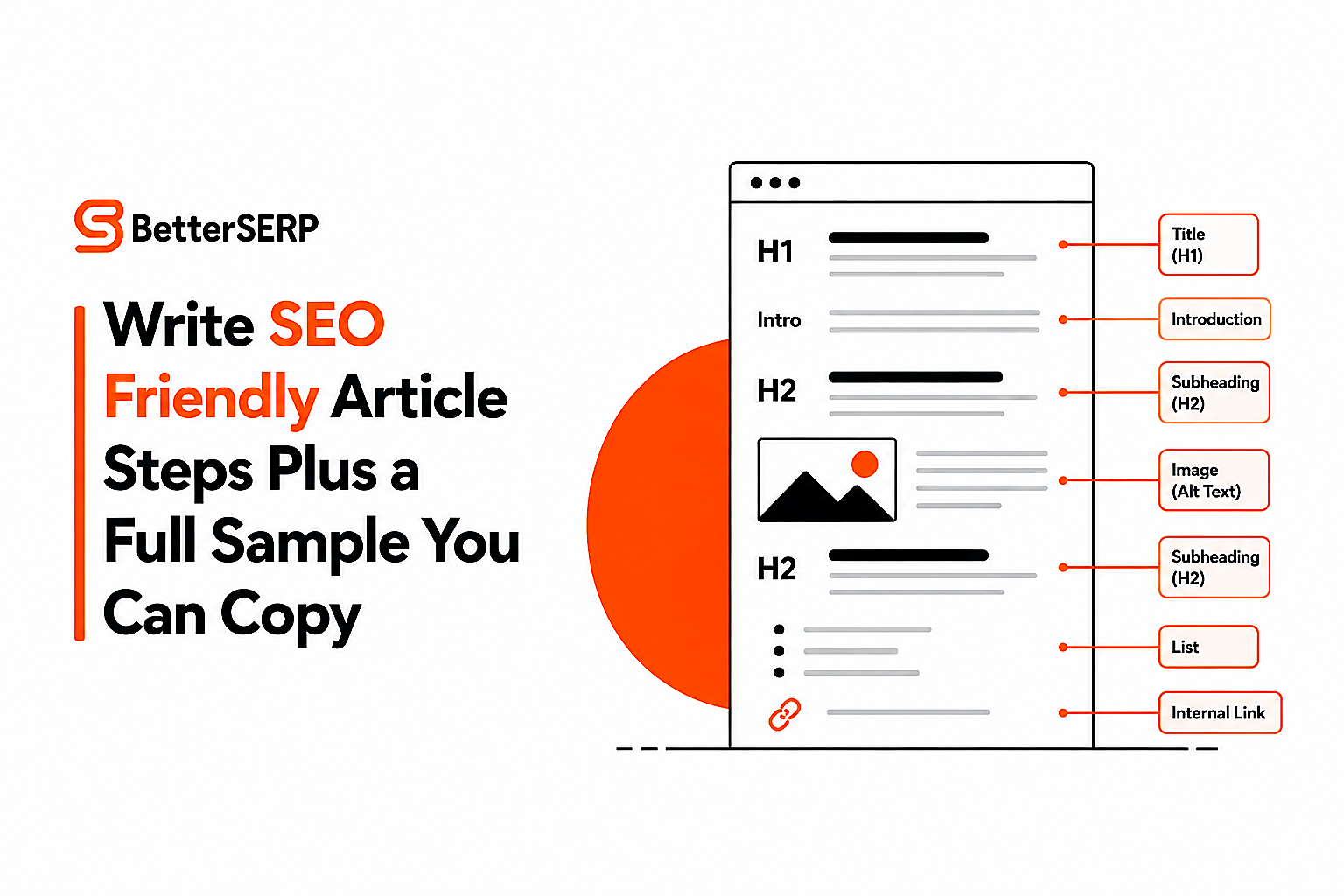
Sample Title (H1): How to Plan a Weekly Meal Prep Routine That Actually Sticks
Suggested URL slug: weekly-meal-prep-routine
Primary keyword: weekly meal prep routine
Supporting phrases: meal prep plan, grocery list, batch cooking, meal prep containers
Intro (2 to 4 sentences): A weekly meal prep routine works when you choose repeatable meals, shop once, and cook in batches so weekday decisions are already made. This guide gives you a simple plan, a grocery workflow, and a one-hour prep template you can repeat every week.
H2: Choose a meal prep goal that matches your week
Snippet-ready answer: Pick one goal, like “3 lunches” or “5 dinners,” so your prep stays realistic and you finish it.
- If time is tight, prep only proteins and vegetables.
- If mornings are hard, prep breakfasts plus grab-and-go snacks.
- If you get bored, rotate two cuisines instead of new recipes daily.
H2: Build a simple meal prep plan using a 3-2-1 formula
Formula: 3 proteins + 2 vegetables + 1 carb base = mix-and-match meals.
- Proteins: chicken thighs, chickpeas, eggs
- Vegetables: broccoli, bell peppers
- Carb base: rice or potatoes
This structure keeps your weekly meal prep routine flexible because you can recombine ingredients into different bowls, wraps, or salads.
H2: Shop once with a “category list” instead of recipe-by-recipe
- Protein: 2 to 3 options
- Vegetables: 4 to 6 total (fresh or frozen)
- Carbs: 1 to 2 staples
- Sauces/spices: 2 flavor profiles (for variety)
H2: Do a one-hour batch cooking session
60-minute template:
- 0 to 10 minutes: start rice/potatoes, preheat oven, wash produce
- 10 to 25 minutes: cook protein #1, chop vegetables
- 25 to 45 minutes: roast vegetables, cook protein #2 (or prep no-cook option)
- 45 to 60 minutes: portion into containers, label, and cool
H2: Store meals safely and keep them appealing
- Cool hot food before sealing containers.
- Keep sauces separate to avoid soggy meals.
- Plan 1 “fresh add-on” (like salad greens) for day-of crunch.
H2: Troubleshoot the two most common failure points
- Problem: you get bored by day 3. Fix: keep the same base, change sauces and toppings.
- Problem: you run out of time. Fix: prep components only, not finished meals.
Annotations showing why this ranks
- Intent match: the article is a practical routine with a template, not a history of meal prep.
- Early answer: the intro states exactly what the guide includes.
- Heading hierarchy: each H2 is an action step, making the page scannable.
- Keyword placement: primary phrase appears naturally in the intro and a body sentence, not repeated in every paragraph.
- Snippet blocks: short “Snippet-ready answer” lines can be lifted into featured snippets.
Optimize the On-Page Deliverables Title, Meta, URL, and FAQ for SERP Features
On-page deliverables help a write seo friendly article workflow by clarifying the page topic for search engines and improving click clarity for humans.
Title tag and H1 guidelines
- Title tag length: aim for about 50 to 60 characters when possible (avoid truncation).
- H1: can be similar to the title, but should read naturally on the page.
- Include: the main topic + a clear benefit (steps, checklist, sample, template).
Meta description guidelines
- Length: keep it under ~155 characters.
- Content: state who it’s for, what it includes, and the outcome.
- Avoid: repeating the title with no added detail.
URL slug rules
- Use lowercase words separated by hyphens.
- Remove filler words when possible (a, the, and).
- Keep it stable, changing URLs later can create redirects and lost equity.
FAQ that earns “People also ask” style visibility
FAQ answers should be short, direct, and standalone. Our team uses a simple rule: each FAQ answer should make sense if it’s read out of context in a search result.
- Pick 3 to 4 questions that beginners repeatedly ask.
- Answer in 40 to 70 words when possible.
- Use consistent formatting so engines can extract it cleanly.
AI-Assisted SEO Writing Workflow, Safe Prompts, and a Human Review Checklist
An AI-assisted workflow helps you write seo friendly article drafts faster when you use AI for structure and iteration, then apply a human review for accuracy, examples, and originality.
Safe prompt pattern for outlining
- Input: keyword, audience, intent statement, and 5 required subtopics.
- Output request: H2/H3 outline, plus a one-sentence summary under each H2.
- Constraint: “No claims that require citations unless you provide a source.”
Safe prompt pattern for drafting sections
- Generate one section at a time to keep quality high.
- Ask for “short paragraphs, numbered steps, and one snippet-ready answer line.”
- Require placeholders for facts: “If you mention a statistic, mark it as [needs source].”
Human review checklist (copyable)
- Intent: does the intro deliver the promised outcome in the first 2 to 3 sentences?
- Structure: do H2s read like answers to real questions?
- Keyword use: does “write seo friendly article” appear naturally (not in every heading or paragraph)?
- Accuracy: remove or source any claims that sound like facts.
- Links: are internal links genuinely helpful and not forced?
- Originality: add one concrete example, checklist, or template that reflects your experience.
- Readability: cut sentences over ~25 to 30 words when they feel hard to scan.
What surprised our team was how often AI drafts fail because they skip specific steps and examples, not because of “bad SEO”. Adding one worked example and a checklist usually fixes that.
| Step | What you do | What “done” looks like |
|---|---|---|
| Intent + brief | Write a one-line intent statement and paste a brief box at the top | You can summarize the page promise in one sentence |
| Outline | Draft H2s that match the reader’s next questions | Headings are skimmable action statements |
| Draft | Write for clarity first, add keyword naturally | Primary keyword appears a handful of times, not everywhere |
| Links + media | Add internal links and 1 to 2 images with descriptive alt text | Every link has a reason to click; images explain something |
| On-page deliverables | Finalize title, meta, slug, and FAQ | All SERP-facing elements are clear and consistent |
FAQ about writing SEO friendly articles
How long should an SEO friendly article be?
Article length should match the intent and the depth of competing results, not a fixed word count. For a “how-to” guide, include enough steps and examples to fully solve the task, then stop. If you can answer the query clearly in 800 words, longer is not automatically better.
How many times should I use my keyword?
Use the primary keyword where it is natural and helpful, typically in the intro, one H2, and a few body mentions. If the phrase starts to sound repetitive, replace it with plain-language alternatives. Keyword stuffing can reduce readability and harm performance.
What is the fastest way to write an SEO friendly article?
The fastest method is to lock intent first, outline H2s as questions, draft quickly for clarity, then run one optimization pass for links, media, title/meta, and FAQ. AI can speed up outlining and first drafts, but a human still needs to verify accuracy, add real examples, and ensure the content is actually useful.
Do internal links really matter for SEO writing?
Internal links help readers find the next step and help search engines understand site structure. Add them when they genuinely support the reader’s goal, and place them where the reader would naturally want more detail. A few relevant links beat many unrelated ones.
If you want to turn this repeatable process into a consistent publishing routine for multiple sites, Better SERP offers reusable workflow templates that help teams standardize briefs, outlines, on-page checks, and scheduling without rewriting the process from scratch each time.
Read Next
View all
What Is SEO Automation, How It Works, And 3 Workflows You Can Copy
Learn what is seo automation, how it works (inputs → logic → outputs), what to automate safely, and 3 copyable workflows with a starter stack.

How To Do SEO For Blog Posts, A Beginner Workflow You Can Repeat
Learn how to do seo for blog with an 80/20 workflow, WordPress checklist, and a 30/60/90-day plan to publish, index, and improve rankings.

How To Optimize Content For Search Engines, A Step-By-Step Workflow You Can Repeat
Learn how to optimize content for search engines with a practical workflow for keywords, on-page fixes, publishing checks, and measurement.